The best white oak transition strip depends on the floor-height difference and the joint type: choose T-molding for floors at the same height, a reducer for a lower adjoining surface, or a threshold for a doorway or perimeter. The American white oak T-moldings suit equal-height transitions, while the European white oak reducer is designed for 1/2-inch flooring. The American white oak threshold fits doorway transitions. A self-adhesive PVC strip is a non-oak alternative for buyers prioritizing simple installation.
| Product | Best For | Material And Length |
|---|---|---|
| American White Oak T-Molding | Same-height floors; longer run | Unfinished oak; 4 feet |
| European White Oak Reducer | 1/2-inch flooring meeting a lower surface | Unfinished oak; 3 feet |
| American White Oak T-Molding | Same-height floors; shorter run | Unfinished oak; 3.5 feet |
| American White Oak Threshold | Doorways and perimeter edges | Unfinished oak; 3 feet |
| Grey Wood Self-Adhesive Strip | Quick, cut-to-fit floor transition | PVC; 4 feet |
American White Oak T-Molding, 4 Feet
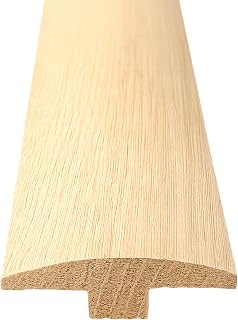
This 4-foot T-molding is best for joining two floors that sit at the same height. It is made from solid, kiln-dried American white oak and arrives unfinished, so it can be sanded, stained, and topcoated to coordinate with the flooring.
The T-shaped profile is intended to cover the expansion gap between surfaces such as hardwood, laminate, tile, and LVP or LVT. The listed features also describe it as suitable for floating floors, where movement at the joint needs to be maintained.
- Best for: Equal-height floor transitions requiring a longer strip.
- Why it was selected: It combines real white oak construction with a finish-ready surface and a stated use for expansion gaps.
- Limitation: It is not the listed choice for bridging a height difference.
European White Oak Reducer, 3 Feet

This reducer is best for a transition from 1/2-inch flooring to a lower surface. Its sloped profile is described as bridging thicker hardwood to materials such as vinyl, tile, concrete, laminate, or LVP and LVT. The 3-foot molding is made from unfinished, kiln-dried European white oak.
The product description notes a neutral grain and color profile intended to pair with common European prefinished oak tones. It is listed as Light Rustic Grade, so occasional small, tight knots may be present.
- Best for: Buyers transitioning 1/2-inch flooring to a lower adjacent surface.
- Why it was selected: It offers an oak reducer profile and specifies the flooring thickness it is designed for.
- Limitation: Confirm the flooring thickness and height change before choosing it; the listed length is 3 feet.
American White Oak T-Molding, 3.5 Feet
This 3.5-foot version is best for same-height floor joints where a shorter piece fits the doorway or transition span. Like the 4-foot option, it is solid, kiln-dried American white oak, supplied unfinished for sanding, staining, and topcoating.
Its T-molding shape is intended to bridge equal-height surfaces and cover the expansion gap. The listed applications include hardwood, LVP or LVT, laminate, and tile-to-wood transitions.
- Best for: Equal-height transitions with a run that suits a 3.5-foot piece.
- Why it was selected: It provides the same described oak material and floating-floor use as the longer option in a shorter length.
- Limitation: It is not a reducer for floors at different heights.
American White Oak Threshold, 3 Feet

This threshold is best for doorways, exterior-door areas, patio or sliding-door thresholds, and perimeter transitions. It is made from unfinished, kiln-dried American white oak and can be sanded, stained, and topcoated to coordinate with the floor.
The listed low-profile, sloped top is intended to create a gentler transition and reduce a pronounced edge. The threshold also covers the expansion gap at a room entry or perimeter.
- Best for: Doorways and edges where flooring meets a threshold, carpet, or lower-profile surface.
- Why it was selected: Its described profile and applications distinguish it from a same-height T-molding.
- Limitation: The listed piece is 3 feet long, so measure the opening before purchase.
Grey Wood Self-Adhesive Transition Strip

This strip is best for buyers who want a cut-to-fit, peel-and-stick option for floor gaps, including carpet-to-tile transitions. It is made from high-density PVC in a grey wood-look finish, not white oak. The listed size is 4 feet by 1.57 inches, with other width options described.
The product description says it can be cut with scissors and installed by cleaning the floor, peeling the backing, and pressing the strip down. It also describes a slim 0.12-inch height and suggests warming the strip with a hairdryer to shape it over curved surfaces.
- Best for: Buyers prioritizing adhesive installation and a low-profile, cut-to-fit strip.
- Why it was selected: It is an alternative for common floor gaps when a solid-oak finish is not required.
- Limitation: It is PVC with a grey wood appearance, not a white oak molding.
Buying Guide: How To Choose A White Oak Transition Strip
Is the floor joint level or uneven?
Use T-molding when the adjoining floor surfaces are at the same height. Choose a reducer when one surface is higher and the strip needs to slope toward a lower floor. For a doorway or perimeter edge, a threshold may be the more appropriate profile. Measure the difference in floor height before selecting a molding.
What material and finish do you need?
Unfinished solid oak can be sanded and stained to coordinate with flooring, but the final color depends on the chosen stain and topcoat. American and European white oak may differ in grain and appearance. If matching a prefinished floor, compare the molding’s stated wood type and grade with the floor sample.
How long should the strip be?
Measure the full transition span and compare it with the listed product length. The oak options here are 3, 3.5, or 4 feet long. Do not assume a molding can cover a wider opening without a seam; plan the layout and any cuts before installation.
Does the floor need room to move?
For floating floors, the product descriptions identify the T-moldings as intended to maintain movement between rooms or materials while covering an expansion gap. Follow the flooring manufacturer’s installation instructions and confirm the transition profile suits the joint.
Frequently Asked Questions
What is white oak T-molding used for?
White oak T-molding covers a joint between floors that are at the same height. The listed options are also described for covering expansion gaps.
When should I use a reducer instead?
Choose a reducer when the flooring transitions from a higher surface to a lower one. The European white oak reducer listed here is specified for 1/2-inch flooring.
Can unfinished oak molding be stained?
Yes. The listed oak moldings are unfinished and described as ready for sanding, staining, and topcoating.
Is the grey self-adhesive strip made of white oak?
No. It is described as high-density PVC with a grey wood-look finish, so it is an alternative rather than a solid white oak transition strip.