For water purification with reverse osmosis, the best choice depends on whether you want a portable countertop unit or an under-sink system. The DREO countertop models are suited to buyers seeking installation-free filtration, while the iSpring adds a remineralization stage and the Waterdrop offers a high-capacity tankless design. Bluevua combines countertop convenience with a glass carafe, UV light, and remineralization.
| Product | Best For | Standout Feature |
|---|---|---|
| DREO Countertop RO Filter | Convenient pitcher-style use | Two autofill pitchers and 3:1 pure-to-drain ratio |
| DREO RO System 112 3L | Monitoring water and filter life | Real-time TDS monitoring |
| iSpring RCC7AK-BN | Under-sink filtration with minerals | Alkaline remineralization stage |
| Waterdrop G3P600 | Higher-capacity tankless filtration | 600 GPD capacity |
| Bluevua RO100ROPOT | Portable filtration with a glass carafe | UV light and remineralization |
DREO Countertop RO Filter With Two Pitchers

Best for: Households that want countertop reverse osmosis without a plumbing installation. The product name lists two autofill pitchers, self-cleaning, TDS and filter-life monitoring, and a 3:1 pure-to-drain ratio.
The listed filtration feature describes a seven-in-one system and states that it filters out 99.9% of possible contaminants, including PFOA, PFOS, chlorine, and fluoride. It also says the system was tested by SGS and meets NSF/ANSI 58 standards. These are manufacturer-provided details, not a substitute for checking a product’s current documentation.
Why it was selected: It combines a countertop format with pitcher convenience and a stated water-saving ratio. Limitation: The supplied feature information does not specify its daily output or the replacement schedule for each filter.
DREO Countertop RO System With TDS Monitoring

Best for: Buyers who want a countertop RO system with visible water-quality and maintenance information. The listed features include real-time TDS readings for raw and purified water, filter-change reminders, an autofill sensor, and automatic flushing of internal tubes.
The product description identifies a seven-in-one filter and says it reduces 99.9% of possible contaminants, including PFOA, PFOS, chlorine, and fluoride. It also states that the system was tested by SGS against NSF/ANSI 58 standards.
Why it was selected: The monitoring and reminder features make it a better fit for people who want maintenance cues rather than tracking filter use themselves. Limitation: The listing does not provide a stated pure-to-drain ratio in the supplied features, so compare water-efficiency information before choosing between it and the other DREO model.
iSpring RCC7AK-BN Under-Sink RO System
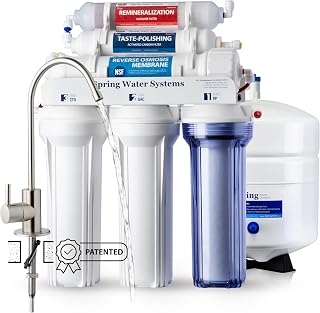
Best for: Homeowners who prefer an under-sink system and want filtered water with a mineral stage. This six-stage system is listed at 75 gallons per day and includes a pH+ remineralization stage intended to add minerals and balance pH.
The top-mounted fastener is designed to make faucet installation possible from above the sink. A transparent first-stage filter housing also lets users see contaminant buildup and assess when a filter change may be needed.
Why it was selected: Its under-sink format and mineral boost distinguish it from the portable countertop options. Limitation: It is not an installation-free countertop purifier; check the installation requirements and available under-sink space before buying.
Waterdrop G3P600 Tankless RO System

Best for: Buyers seeking a tankless under-sink system with a stated capacity of 600 gallons per day. The eight-stage filtration system is described as reducing TDS and a range of substances, including PFAS, fluoride, arsenic, chlorine, and lead-related contaminants.
The product information lists NSF/ANSI 58 certification for TDS reduction, NSF/ANSI 372 certification for lead-free material, and NSF 42 certification for reducing chlorine, taste, and odor. Its smart display faucet includes a TDS monitor and filter-life tracker.
Why it was selected: It pairs a high stated daily capacity with certification information and filter monitoring. Limitation: This is a tankless under-sink system, not a portable countertop option; check its installation requirements before purchase.
Bluevua RO100ROPOT Countertop System

Best for: Renters or other buyers who want a portable, no-plumbing RO system and prefer a glass carafe. Its six-stage filtration includes a 0.0001-micron RO membrane, UV light, and a remineralization filter.
The product information says the system reduces TDS, PFOA, PFOS, chlorine, fluoride, arsenic, and lead. It is described as WQA-certified against NSF/ANSI/CAN 372 for lead-free materials and tested by SGS. The unit has a stated 2:1 pure-to-drain ratio and enters standby mode when not in use.
Why it was selected: The glass carafe, mineral stage, and countertop setup offer a distinct combination of features. Limitation: Its countertop format requires filling the unit’s water container; it does not provide the continuous feed of an installed under-sink system.
Buying Guide: How To Choose A Reverse Osmosis System
Should you choose countertop or under-sink filtration?
Countertop systems suit buyers who want to avoid plumbing work or need a portable option. Under-sink systems are better for a more permanent setup and may offer greater stated daily output. Compare available counter or cabinet space, installation needs, and how much filtered water your household uses.
Do you want remineralization after reverse osmosis?
Some systems, including the iSpring and Bluevua models here, include a mineral stage. If this feature matters to you, check which minerals the product says it adds and whether the stage is part of the listed filtration sequence. Do not assume every RO system includes remineralization.
Which monitoring features are useful?
TDS displays can show a reading for dissolved solids in feed or filtered water, while filter-life indicators provide a maintenance reminder. These features support routine monitoring, but they do not identify every substance in water. Review the product’s stated contaminant-reduction information for your priorities.
How should you compare water efficiency and capacity?
Compare the listed pure-to-drain ratio, if available, and the system’s stated daily capacity. A ratio describes water produced versus water sent to drain; it is different from total daily output. The figures provided here vary by model, and not every listing supplies both measurements.
What certification information should you verify?
Look for the exact standard and the claim associated with it. NSF/ANSI 58 relates to reverse osmosis system performance, while other standards may address specific materials or contaminant reductions. Confirm current certification details and the specific model configuration in the manufacturer’s documentation.
Frequently Asked Questions
What does reverse osmosis water purification do?
Reverse osmosis pushes water through a semipermeable membrane as part of a filtration system. The specific substances reduced depend on the system, its filters, and its verified performance claims.
Does every reverse osmosis system remove the same contaminants?
No. Contaminant-reduction claims differ by model and filter configuration. Check the product’s stated reductions and supporting certification or test information rather than assuming all RO systems perform identically.
Is a countertop reverse osmosis system easier to install?
Countertop systems are generally designed to operate without plumbing installation, while under-sink models require a more permanent setup. Follow each product’s installation instructions and confirm what the selected model requires.
Does a TDS reading show whether water is completely safe?
No. A TDS reading measures total dissolved solids, not every possible contaminant. Use it as one monitoring measure and consult the system’s specific performance information for substances of concern.
Do reverse osmosis systems need filter changes?
Yes. Filter replacement is part of ongoing maintenance. Follow the manufacturer’s schedule and use any built-in filter-life reminders as guidance when the model includes them.