The best solar powered roof fan depends on the space, airflow target, and whether ventilation must continue after sunset. The iLIVING model is a strong choice for thermostat control and adjustable panel positioning; VEVOR emphasizes high airflow; and the Hon&Guan offers dual-power operation and adjustable speed. The remaining picks suit buyers who prioritize simple daylight operation or ventilation for smaller spaces.
| Product | Best For | Listed Airflow |
|---|---|---|
| iLIVING Hybrid Ready | Thermostat and panel adjustment | 1,150 CFM |
| VEVOR 35W | High stated airflow | Up to 2,400 CFM |
| 40W Controller-Free Fan | Simple daytime operation | 1,800–2,000 CFM |
| 25W Dual-Power Fan | Small spaces and supplemental power | 432 CFM |
| Hon&Guan 40W | Adjustable speed and day-night operation | Up to 2,000 CFM |
iLIVING Hybrid Ready Smart Thermostat Fan

The iLIVING Hybrid Ready fan is best for homeowners who want temperature-based operation and the ability to adjust solar-panel angle. Its listed specifications include a 40-watt panel, 1,150 CFM airflow, and coverage of up to 2,900 square feet. The thermostat control is adjustable from 50°F to 122°F and includes an enable/disable feature.
The panel adjusts to 0°, 15°, 30°, or 45°, which gives buyers several positioning options. The product listing also specifies an IP68 waterproof brushless motor and a 15-year warranty. It was selected for its combination of thermostat controls and panel-angle adjustment. Its stated airflow is lower than the VEVOR and other 40-watt picks, so compare airflow needs rather than coverage claims alone.
VEVOR 35W Solar Attic Fan

The VEVOR is best for buyers prioritizing high stated airflow from a solar-powered attic fan. The listing gives a maximum output of 2,400 CFM and describes an MPPT solar controller designed to maximize power from available sunlight. It also names metal and masonry roofs as suitable roof types.
A built-in thermostat starts the fan when attic temperature exceeds 26°C (79°F), according to the listing. The brushless DC motor and weatherproof construction are additional stated features. This model was selected for its high airflow rating and automatic temperature control. Because operation is solar-powered, available ventilation depends on sunlight; the listing does not specify battery backup for nighttime use.
40W Controller-Free Solar Roof Fan

This 12-inch fan is best for buyers who prefer straightforward, controller-free daytime ventilation. The product description lists a 40-watt solar panel and airflow of 1,800–2,000 CFM. It says the fan starts at sunrise and stops at dusk, without complex wiring or a separate thermostat or controller.
The listing describes a heavy-duty copper motor, metal blades, a hail-resistant metal housing, and an IP65 weather-resistant design. It was selected for buyers who value a simple operating setup and substantial stated airflow. Avoid this option if you need the fan to run overnight or want temperature-triggered controls; those features are not listed for this model.
25W Dual-Power Solar Exhaust Fan

The 25-watt model is best for smaller outbuildings or buyers who want an included adapter as an alternative to solar-only operation. The listing states 432 CFM airflow, a brushless motor, and solar-plus-adapter power. It describes the adapter as enabling continuous ventilation and says no batteries are required.
Listed uses include a chicken coop, greenhouse, shed, attic, barn, and garage. Its UV-stabilized ABS housing and corrosion-resistant aluminum mesh are described as rain-, snow-, and dust-resistant. This pick was selected for its dual-power design and broad small-space applications. Its 432 CFM rating is substantially below the other options here, so it may not suit buyers seeking high-volume attic exhaust.
Hon&Guan 40W Thermostat Solar Fan
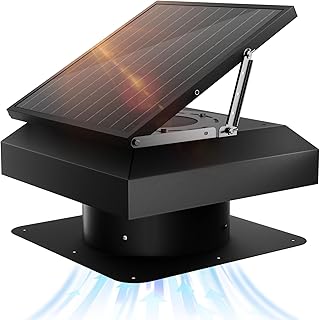
The Hon&Guan fan is best for buyers who want adjustable speed, thermostat options, and an AC/DC adapter for day-and-night operation. Its listed airflow reaches 2,000 CFM, with stated coverage up to 2,500 square feet. The solar panel adjusts from 0° to 70° horizontally and vertically.
The product listing describes two operating modes. Energy-saving mode varies airflow with sunlight, while performance mode offers four speed settings and requires the adapter. The thermostat can be enabled or disabled, with a listed setting range of 68°F to 113°F. This model was selected for its control flexibility. The listing specifies no battery backup, and performance mode requires the AC/DC adapter.
Buying Guide: How To Choose A Solar Powered Roof Fan
How much airflow do you need?
Compare the listed CFM ratings, but do not treat airflow as the only selection factor. The products range from 432 CFM to a stated maximum of 2,400 CFM. Match the fan to the space and its ventilation requirements, and verify that the product’s mounting arrangement suits the roof or structure. Coverage figures are manufacturer-provided claims and are not directly interchangeable with CFM.
Do you need ventilation at night?
Solar-only fans generally rely on available sunlight, and some listings explicitly describe operation from sunrise to dusk. If you need operation after dark or during low-light conditions, consider a product with an AC adapter or another specified power option. The 25W dual-power and Hon&Guan models list adapter-based operation; neither listing describes battery backup.
Would thermostat or speed controls help?
A thermostat can trigger ventilation based on temperature rather than relying only on manual operation. The iLIVING, VEVOR, and Hon&Guan listings include thermostat features. Hon&Guan also lists four speed settings in performance mode. Choose a simpler controller-free model if automatic sunrise-to-dusk operation better fits your needs.
What should you check before installation?
Confirm roof material, opening dimensions, panel exposure, and the product’s mounting instructions before buying. Solar-panel angle and placement affect access to sunlight; adjustable panels can offer more positioning choices. Also compare weather-resistance claims and any required adapter or controls. Product listings do not establish that every fan will fit every roof or building.
Frequently Asked Questions
Can a solar roof fan run at night?
A solar-only fan depends on sunlight and may stop when the sun is unavailable. Models with an included AC adapter can offer an alternative power source; check the listed operating modes.
Does a solar attic fan need a thermostat?
No. A thermostat is useful for temperature-triggered operation, but controller-free fans can operate automatically according to sunlight. Choose based on the controls you want.
What does CFM mean on a roof fan?
CFM means cubic feet per minute, a measure of airflow. A higher stated CFM indicates a higher airflow rating, but suitability also depends on the space and installation.
Are solar roof fans suitable for sheds and garages?
Some listings name sheds and garages as intended applications. Check the fan’s airflow, mounting requirements, power options, and dimensions against the specific building before purchasing.