The best shallow well filter system depends on which contaminants you need to address: sediment, iron, chlorine, odors, or other impurities. These five options include complete multi-stage systems, a simpler single-stage filter, and a clear filter housing. The three-stage Virego is best for buyers prioritizing fine-particle filtration and stated flow capacity; PUREPLUS’s two-stage system is better suited to households concerned about iron and odor. Test well water before choosing a filter, because no single system addresses every possible water-quality issue.
| Product | Best suited for | Notable feature |
|---|---|---|
| Three-stage system with filter supply | Buyers seeking replacement cartridges included | Three sets of cartridges |
| PUREPLUS two-stage system | Well water with sediment and iron concerns | Composite iron-removal and carbon filters |
| Virego three-stage system | Buyers comparing filtration stages and flow | 0.5-micron PP filter; stated 15 GPM |
| PUREPLUS one-stage system | Buyers seeking a simpler filtration approach | Designed for sediment, rust, and heavy metals |
| PUREPLUS filter housing | Buyers needing a housing with pressure monitoring | Clear housing and pressure gauge |
Three-Stage System With Two-Year Filter Supply

This system is best for households that want a multi-stage filter and replacement cartridges in the same box. It has three filtration stages and includes three full sets of cartridges, which the product describes as a 1.5- to 2-year supply. A built-in bypass valve is intended to make installation and filter changes easier.
The listed filtration targets include sediment, chlorine, odors, and other impurities. The system is described for well or city water and whole-house use. Choose it if reducing routine cartridge purchasing is a priority. Its stated limitation is important: it does not lower TDS or remove natural minerals. Check the filter specifications against a well-water test before relying on it for a particular contaminant.
PUREPLUS Two-Stage Filter for Well Water
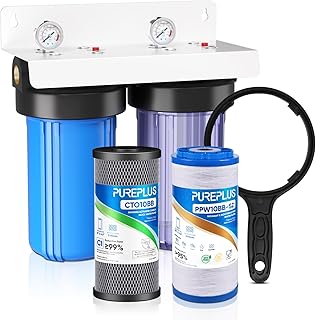
This PUREPLUS system is best for buyers whose well-water concerns include sediment, suspended particles, and iron, along with chlorine or unpleasant odors. Its first cartridge combines a polypropylene filter with an iron-removal filter. The second is a carbon block cartridge intended to reduce chlorine, odors, and organic compounds.
The two-cartridge design gives buyers clearly defined filtration roles in one system. Choose this model if iron reduction is a priority and its listed filter targets match your test results. The provided product information does not state a flow rate, micron rating, or cartridge replacement interval, so confirm those details for your plumbing and maintenance needs before purchasing.
Virego Three-Stage Filter With Brass Ports

This is best for households comparing a stated flow capacity with staged sediment and carbon filtration. Its three cartridges are a 0.5-micron polypropylene sediment filter, a GAC activated-carbon filter, and a CTO carbon-block filter. The product lists a flow rate of up to 15 gallons per minute and 3/4-inch NPT brass ports.
The system is described for both well and city water and is intended to reduce sediment, rust, chlorine, odors, and unpleasant tastes. It does not use electricity or produce wastewater, according to the product details. Choose it if those targets and its stated flow rate suit your household. It preserves dissolved minerals and does not reduce TDS, so it is not a solution for lowering total dissolved solids.
PUREPLUS One-Stage Well Water Filter

This model is best for buyers considering a simpler whole-house filter for common well-water concerns. The product describes filtration for sediment, rust, and heavy metals, and highlights a high flow rate intended to maintain water pressure during simultaneous household use. It also describes the housing as durable for well-water applications.
Choose this option if its listed contaminant targets match your water test and you do not need the clearly specified three-cartridge arrangement found in other options here. The available details do not give a numeric flow rate, a micron rating, or the specific heavy metals addressed. Confirm those points and cartridge requirements before selecting it for a particular water problem.
PUREPLUS Clear Filter Housing With Gauge

This product is best for buyers who need a whole-house filter housing and want a pressure gauge for monitoring. It has a clear housing, a 1-inch NPT connection, a pressure-release valve, a mounting bracket, a wrench, and installation hardware, according to its listing. The housing is described as food-grade polypropylene with brass at the threaded connection.
It is intended for installation on the main water line and can hold a filter cartridge, but the provided product details do not specify an included cartridge or its filtration targets. Choose it if you are selecting a housing and understand which compatible cartridge you need. Avoid treating it as a complete contaminant-specific system without confirming what filter media is included or required.
Buying Guide: How to Choose a Shallow Well Filter
What does your well water need to filter?
Start with a water test rather than choosing by the word “well” on a product listing. Sediment, iron, odor, and other water-quality issues call for different treatment approaches. Compare the test results with each system’s stated targets. If a contaminant is not listed, do not assume the filter removes it.
How many filtration stages do you need?
Multi-stage systems assign different jobs to different cartridges. For example, a sediment filter may capture particles, while carbon media targets taste, odor, or chlorine. More stages do not automatically mean a system handles every well-water concern. Check the media types and their specified uses.
Will the system fit your plumbing and household flow?
Check inlet and outlet size, connection type, available installation space, and the product’s stated flow capacity. A listed maximum flow rate is useful for comparison, but it does not replace checking the plumbing requirements for your home. If a listing gives no numeric rate, ask the seller or consult the product documentation.
What should you know about maintenance?
Compare how many replacement cartridges are included, the stated replacement schedule, and whether cartridges are available for the housing. A bypass valve or pressure-release feature may help with servicing, but follow the product instructions. Do not assume a cartridge supply lasts a fixed period under every household’s water conditions.
Frequently Asked Questions
Can a whole-house filter remove every well-water contaminant?
No. Filter performance depends on the cartridge media and the contaminants it is designed to address. Test the water and match the results to the system’s stated capabilities.
Does a sediment filter lower TDS?
Not necessarily. The first and third systems listed here explicitly state that they preserve minerals and do not reduce TDS. Check product specifications if lowering TDS is a goal.
Is a filter housing the same as a complete filter system?
Not always. A housing holds a cartridge, but the housing listing may not include filter media. Confirm the cartridge requirements and included components before buying.
Should I choose one, two, or three filtration stages?
Choose based on your test results and the stated role of each cartridge, not stage count alone. A system with more stages is not automatically appropriate for every well.
Do these systems treat bacteria or make water safe to drink?
The provided product details do not establish that these systems disinfect water or address bacteria. If microbial safety is a concern, use appropriate testing and seek treatment guidance from a qualified water professional.