Answering the question, this guide highlights reliable, easy-to-install baseboard heater thermostats for older 120V and 240V systems. The selections favor units that are programmable, line-voltage, and compatible with standard Cadet, Mysa, and similar heaters. This helps buyers choose the right thermostat style for legacy baseboard setups, whether upgrading for better accuracy or adding smart control. The best options balance simplicity, compatibility, and predictable performance for rooms that rely on older heating infrastructure.
| Product | Voltage Range | Best For |
|---|---|---|
| 240V Only 4-Wire Manual Electric Baseboard Thermostat (YeloDeer) | 240V | Traditional 240V baseboard systems |
| Mysa Smart Thermostat LITE (Electric Baseboard) | 120V-240V | Smart control for mixed zones |
| Cadet F Series Double Pole Built-In (BTF2W) | 120/208/240V | Cadet baseboard replacements |
| Cadet Double Pole Line Voltage Thermostat | 120/208/240V | Versatile line-voltage upgrade |
| 110V-265V 4-Wire Manual Electric Baseboard Thermostat (YeloDeer) | 110-265V | Broad voltage compatibility, older and newer wiring |
240V Baseboard Thermostat With 4-Wire Control

This white, flush-mount device offers a large knob for easy temperature adjustments on 240V, up to 4800 W. Its design matches standard baseboard heaters and provides higher accuracy than traditional mechanical thermostats. Best for single-room, fixed installations where a simple, non-smart control is sufficient.
Who it’s best for: homeowners decorating a room with a modern, discrete look and a need for precise 40°F–80°F control. Why selected: strong basic control for 240V systems, reliable knob adjustment, and flush placement minimize wall intrusion. Caution: lacks smart features; cannot be controlled remotely without an external add-on.
Mysa Smart Thermostat LITE For Baseboard Heaters

Smart, WiFi-enabled thermostat compatible with 120V-240V systems. It supports 7-day scheduling, remote control, and voice integration with HomeKit, Alexa, and Google. Best for: households seeking energy savings and armchair convenience. Why selected: strong energy-saving features with cloud and app control. Caution: requires WiFi and a compatible app; may be unnecessary for strictly manual setups.
Cadet F Series Double Pole Built-In Thermostat (BTF2W)

This Cadet model is designed for Cadet F series heaters, offering a 45º–80ºF range via a large dial. It mounts at either end of the baseboard heater, simplifying installation. Best for: users with Cadet systems seeking a straightforward, end-mount replacement. Why selected: easy integration with Cadet kits, dependable double-pole switching. Caution: compatibility is limited to Cadet F series heaters.
Cadet Double Pole Line Voltage Thermostat

Line-voltage thermostat supporting 120, 208, and 240 volts. It switches both legs of the circuit and can handle up to 5,280 watts at 240V. Best for: users upgrading from a non-smart, older wall thermostat who want a robust, DIY-friendly replacement. Why selected: broad compatibility, straightforward twist-dial control (40–80°F), with an off position for complete shutdown. Caution: professional wiring may be required for some installations; ensure correct wire-color matching.
110V-265V 4-Wire Manual Electric Baseboard Thermostat
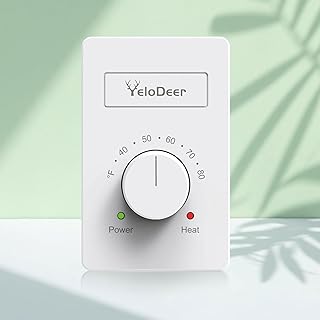
This device supports a wide voltage range from 110V to 265V with a 4-wire, single-pole design and a 40°F–80°F control, suitable for mixed or evolving heating setups. Best for: homes with varying voltage requirements or renovations that may update wiring. Why selected: broad voltage compatibility and precise, non-smart regulation. Caution: confirm wire gauge and terminal sizes (max. 12 AWG) before installation.
Buying Guide: Key Considerations For Old Baseboard Thermostats
What type of baseboard system do you have? Identify whether your setup is single-pole or double-pole, and confirm voltage (120/208/240V). Double-pole thermostats are safer for line-voltage heaters because they disconnect both live wires. Consider compatibility with your heater brand, such as Cadet, which often performs best with Cadet-specific models.
Do you want smart control or a simple manual dial? Smart thermostats offer scheduling, remote control, and energy savings but require WiFi and app setup. Manual dial thermostats provide immediate, reliable control without network needs and generally have longer, simpler installation steps.
Accuracy and temperature range matter. A tighter control range (for example, a 3–6 degree hold) can maintain steadier comfort but may require more precise wiring. Look for thermostats with clear temperature ranges and high accuracy for consistent room comfort.
Installation considerations. Some models mount at the end of the heater, others flush to the wall. Ensure you have enough clearance and understand whether wiring upgrades are necessary. If replacing an old thermostat, verify if the new model is compatible with your existing wiring and control scheme.
FAQ
- What is a line-voltage thermostat? Answer: A thermostat designed to switch high-voltage heating elements directly, typically for baseboard heaters, controlling 120/208/240V circuits.
- Are smart thermostats compatible with all baseboards? Answer: Not always; some baseboard heaters require line-voltage thermostats, while smart options may need specific wiring or modules.
- How do I know if I need a single-pole or double-pole thermostat? Answer: Single-pole switches one hot line; double-pole switches both hot lines, offering more complete shutdown and safety on 240V circuits.
- Can I install a new thermostat myself? Answer: Many line-voltage thermostats are DIY-friendly, but wiring mistakes can be dangerous. If unsure, hire a licensed electrician.
- Will a smart thermostat save energy on baseboard heating? Answer: Yes, with programmable schedules and remote control, depending on daily usage patterns and climate.
- Do these thermostats work with all voltages and heater brands? Answer: Compatibility varies; always confirm the model’s voltage range and heater compatibility before purchase.