For marine aquariums and reef tanks, choose a reverse osmosis/deionization (RO/DI) system designed to produce low-TDS water. The LiquaGen Shark is best for high-volume use, while the LiquaGen 150 GPD unit suits smaller aquarium setups and includes a TDS meter and pressure gauge. The other three products are under-sink drinking-water systems, not dedicated marine RO/DI units; they may suit household water needs but are not direct substitutes for aquarium DI filtration.
| Product | Best For | Key Distinction |
|---|---|---|
| LiquaGen Shark 4-Stage RO/DI | High-volume marine and reef use | 1000 GPD; dual DI filters |
| LiquaGen 5 Stage RO/DI | Smaller aquarium setups | 150 GPD; TDS meter and pressure gauge |
| iSpring RCC7AK-BN | Household drinking water | 75 GPD; remineralization stage |
| Waterdrop T3-T | Faster-flow household drinking water | 220 GPD; seven-stage filtration |
| APEC ROES-50 | Basic under-sink drinking-water filtration | 50 GPD; five-stage filtration |
LiquaGen Shark 4-Stage RO/DI

Best for: Reef keepers, marine aquariums, or other applications that need high-volume purified water. The product is described as a commercial-grade RO/DI system with a 1000 GPD capacity and dual post-deionization filters.
Its listed features emphasize ultra-pure, zero-TDS output for sensitive uses such as coral tanks and labs. It operates on standard household or commercial line pressure, and a booster pump can be added if higher output is needed. That makes it the strongest choice here for users prioritizing production capacity.
Limitation: The stated output depends on the installation and operating conditions; a booster pump may be needed for a particular setup. Check the seller’s current specifications and installation requirements before choosing it.
LiquaGen 5 Stage 150 GPD RO/DI

Best for: Marine and reef aquarists who want an aquarium-focused RO/DI system with monitoring tools included. Its listed components are a 5-micron sediment filter, UDF carbon, carbon block, high-rejection RO membrane, and color-changing mixed-bed DI resin.
The unit is rated at 150 GPD and includes a TDS meter and pressure gauge, which help users monitor source-water conditions and system operation. The seller lists uses including reef aquariums, saltwater tanks, and freshwater systems. It is a practical comparison to the higher-capacity Shark when the stated 1000 GPD capacity is not the priority.
Limitation: The product notes that membrane performance depends on proper pressure and temperature. Actual production and water quality can vary with feed-water conditions.
iSpring RCC7AK-BN Alkaline RO System
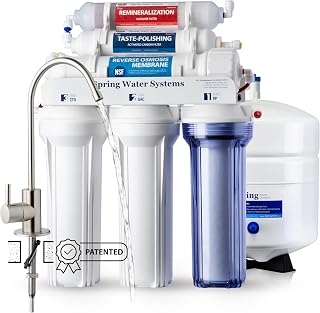
Best for: Households seeking under-sink drinking-water filtration with a remineralization stage. The listed features include a 75 GPD rating, a mineral-boost stage, and a transparent first-stage housing for viewing filter buildup.
The patented top-mounted fastener is designed to make countertop faucet installation easier from above the sink. The alkaline stage adds minerals to treated water, a feature aimed at drinking-water preferences rather than aquarium preparation.
Limitation: This is a household RO system, not a dedicated marine RO/DI unit. Its listed features do not include a DI stage, so reef keepers should not treat it as equivalent to the aquarium-focused options.
Waterdrop T3-T 220 GPD RO System

Best for: Homes that want a higher stated production rate for drinking and cooking water. The manufacturer lists 220 GPD and seven-stage filtration, with tested reduction claims for a range of contaminants. The system does not require power, according to the product details.
This model is a better household option than the 50 or 75 GPD systems if faster water production is a priority. Its listing states a 2:1 pure-to-drain ratio and SGS testing referred to NSF/ANSI 58. It also notes NSF/ANSI 372-certified lead-free materials.
Limitation: Faucet installation requires drilling a hole in the countertop. It is not listed as an aquarium RO/DI system and does not include a DI stage.
APEC Water ROES-50 5-Stage System

Best for: Buyers seeking a straightforward under-sink drinking-water system with a 50 GPD rating. APEC lists five-stage filtration and says the system is designed to reduce substances such as arsenic, chlorine, lead, fluoride, and heavy metals.
Quick-connect fittings and colored tubing are listed as installation and maintenance features. This option fits household use where a lower stated production rate is acceptable and the goal is filtered water from the kitchen tap.
Limitation: The product is described as a home drinking-water system, not an RO/DI unit for marine aquariums. It does not list a deionization stage.
Buying Guide: How to Choose a Marine RO System
Do you need RO or RO/DI for a reef tank?
For reef and marine aquarium use, look for a system that explicitly includes reverse osmosis and deionization. RO reduces dissolved substances, while the DI stage is intended to further polish the water. The two LiquaGen products in this list are the aquarium-oriented choices; the household systems do not list DI filtration.
How much water do you need to make?
Compare the stated GPD capacity with your water-change schedule and top-off needs. The Shark is listed at 1000 GPD, while the LiquaGen aquarium unit is rated at 150 GPD. These figures are product ratings, not guarantees of real-world output; pressure, temperature, and feed-water conditions can affect production.
Which monitoring features are useful?
A TDS meter and pressure gauge can help aquarium owners check system operation and water quality indicators. The LiquaGen 150 GPD product lists both. Its color-changing DI resin also provides a visual indication of resin condition, according to the product description.
Is a household RO system suitable for marine water?
Not as a direct substitute for RO/DI when preparing reef water. The iSpring, Waterdrop, and APEC models are presented as drinking-water systems. Their listed features do not include DI filtration, so choose an aquarium-specific system if DI-treated water is required.
What should you confirm before installation?
Check the product’s current installation instructions, feed-water requirements, available space, and required connections. For the Waterdrop system, the listing specifically says faucet installation requires countertop drilling. For the LiquaGen systems, consider whether available line pressure is suitable for the desired output.
Frequently Asked Questions
What does RO/DI mean?
RO/DI means reverse osmosis followed by deionization. It describes a filtration setup with both an RO membrane and a DI stage.
Which listed product is made for reef aquariums?
The LiquaGen Shark and the LiquaGen 5 Stage 150 GPD are specifically described for aquarium, reef, marine, or coral applications.
Does higher GPD always mean better performance?
No. A higher listed GPD means a higher stated production capacity, but actual output depends on operating conditions such as pressure and temperature.
Can I use a drinking-water RO system for a marine tank?
The three under-sink models here are not listed as RO/DI aquarium systems. Their product details do not include a DI stage, so they are not direct replacements for the aquarium-focused options.
Why does an aquarium RO/DI system include a TDS meter?
A TDS meter measures total dissolved solids in water. It can help users monitor the system’s output, although the meter alone does not identify individual substances.