Looking for a large hot water tank that balances capacity, efficiency, and ease of installation? This guide highlights five practical options suited for families, small homes, apartments, and point-of-use needs. Each product is evaluated for who it’s best for, and why it stands out, with clear pros and one notable caveat. Use the quick-reference table to compare key points at a glance.
| Product | Capacity | Best For | Notes |
|---|---|---|---|
| VEVOR Electric Water Heater (18 gal) | 18 gal | Families needing ample on-demand hot water | High power and enamel coating |
| GE 18 Gal Versatile Plug & Play | 18 gal | Compact homes needing easy installation | 120V, flexible hookup |
| GE 18 Gal Side Port Lowboy | 18 gal | Tight spaces, 1–2 person households | Lowboy design for limited height |
| VEVOR 6 Gal Tank Water Heater | 6 gal | Small apartments and RVs, extra source | Compact, good insulation |
| ThermoMate 8 Gal Point-of-Use | 8 gal | Booster for sinks, kitchens, baths | 8 gal POU with adjustable thermostat |
VEVOR Electric Water Heater, 18 Gallon Tank

The 18-gallon capacity supports family needs for showers, dishwashing, and laundry with a quick-recovery 1600W heating element. It uses an immersion heating element for continuous hot water delivery around the clock, and a user-friendly LED display with a rotary thermostat adjustable from 30°C to 75°C (86°F to 167°F). An enamel coating adds safety against leaks and burns, making this model suitable for moderate households requiring reliable hot water in several outlets.
Best for: Families or roommates who want a larger storage unit with fast heating and clear temperature control. Use caution: ensure proper ventilation and electrical capacity to support continuous operation at high power.
GE Appliances 18 Gallon Versatile Plug & Play Electric Water Heater

This model emphasizes whole-home flexibility within small spaces. It’s designed for quick installation using standard 3/4-inch NPT connections and a 120-volt supply, making it ideal for single-point usage or small homes, apartments, cabins, or garages. The compact footprint helps it fit in limited spaces such as kitchens, bathrooms, and utility rooms.
Best for: Homeowners seeking an easy, quick install in limited spaces or a primary hot water source for a compact dwelling. Limitation: may be best for one or two outlets rather than high-demand simultaneous use.
GE Appliances 18 Gallon Versatile Electric Water Heater (Lowboy)
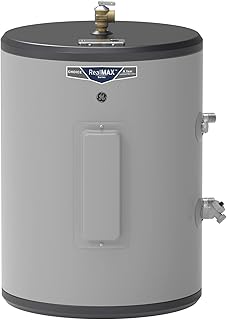
The lowboy design makes this unit ideal for spaces where height is restricted, such as under sinks or in crowded utility rooms. With a capacity of 18 gallons, it accommodates a small family of 1–2 residents with reliable hot water. Setup uses standard plumbing and electrical connections, simplifying replacement and upgrades.
Best for: Small households or retrofit projects in tight spaces. Caution: ensure the layout can accommodate its height and connection points without interference with nearby fixtures.
VEVOR Electric Tank Water Heater, 6 Gallon

With a 6-gallon capacity, this compact heater is well-suited for single apartments, RVs, or as a supplementary hot water source for kitchens and bathrooms. It features a fast-heat immersion tube, thick insulation, and an IPX4 waterproof rating for added safety in damp environments. The unit’s small footprint makes it easy to place near point-of-use fixtures.
Best for: Studio apartments, dorms, or as a booster unit to improve warm-water availability. Limitation: limited capacity means not ideal for whole-house hot water when multiple outlets are used simultaneously.
ThermoMate 8 Gal Point-of-Use Tank

This 8-gallon unit is tailored for point-of-use installations where instant hot water is needed at a sink or small bathroom. It features a compact 20.75-inch low profile and a 1500W INCOLOY-800 heating element known for corrosion resistance and efficiency. It is well-suited for kitchens, bathrooms, RVs, or boats where space is at a premium.
Best for: Boosting hot water at a single fixture or small-space applications. Caution: hard-wired installation is required, which may require professional setup in some homes.
Buying Guide: Key Considerations For Large Hot Water Tanks
- Capacity vs. demand: Match the tank size to your household’s hot water usage. Larger families benefit from 18-gallon models, while singles or RVs can optimize with 6–8 gallon units as a booster or point-of-use solution.
- Power source and installation: 120V plug-and-play units are easiest to install in small spaces, while higher-voltage options may require dedicated circuits. Check available electrical capacity and plumbing connections before purchasing.
- Recovery rate and heating element: Higher wattage yields faster recovery. Immersion tubes and high-quality enamel coatings improve durability and heat retention, reducing standby losses.
- Space constraints: Lowboy or compact designs help in tight kitchens, closets, or under-sink placements. Measure installation spaces to avoid mismatches.
- Safety features: Look for IP rating (water resistance), overheating protection, and robust interior coatings to prevent corrosion and leaks.
- Maintenance needs: Consider ease of drainage, access to components, and warranty terms to minimize downtime and repair costs.
FAQ
- Q: What size tank should I choose for a family of four? A: An 18-gallon tank is commonly suitable for households with multiple simultaneous hot water needs, depending on faucet use and recovery rate.
- Q: Are plug-and-play 120V heaters sufficient for whole-home usage? A: They work well for limited or single-point needs but may struggle with high simultaneous demand in larger homes.
- Q: Do I need professional installation for lowboy or high-capacity models? A: It depends on electrical and plumbing requirements; some units are designed for DIY replacement, while others may require professional hookup.
- Q: What is the benefit of an enamel-coated interior? A: Enamel coatings improve safety and longevity by resisting corrosion and leaks over time.
- Q: Can these units be used in RVs or boats? A: Some models are suitable for RVs, boats, or compact spaces, but verify the voltage, insulation, and mounting options for mobile use.
- Q: How do point-of-use heaters differ from whole-home models? A: Point-of-use units provide hot water at a specific fixture, reducing wait times but not supplying multiple outlets simultaneously.