The best choice depends on whether you need a cabinet door that pivots and stores inside the cabinet, or a full-size door that slides along a wall. The Knape & Vogt pivot kit is the clearest match for a cabinet flipper-style application, while the two cabinet pocket-door kits are options for concealing cabinet doors. The SMARTSTANDARD and FINOSEN kits are sliding-door systems, not cabinet flipper slides, so consider them only for larger door projects.
| Product | Best suited for | Key distinction |
|---|---|---|
| Knape & Vogt Pivot Door Slide | Inset cabinet doors | Pivot hardware; 30-pound capacity per door |
| Pisman 12-Inch Pocket Door Kit | Cabinet or wardrobe doors | Two concealed slide sets |
| Lipshome Cabinet Pocket Door Slide | Inset cabinet projects | Cabinet pocket-door hardware |
| SMARTSTANDARD 6-Foot Bypass Kit | Room-sized bypass doors | Track kit with finger pull |
| FINOSEN 8-Foot Track Kit | 36- to 48-inch doors | Top-mount aluminum track |
Knape & Vogt Pivot Door Slide Kit

Best for: Cabinet makers who need inset doors that pivot and move out of the way. This is the most directly relevant product here for a flipper-style cabinet application: the listing specifies inset use, self-closing operation, adjustable hinges, and precision steel ball-bearing slides.
Each door requires one kit. It is designed for doors 5/8 to 3/4 inch thick and lists a 30-pound capacity per door, with a maximum door size of 24 by 42 inches. A rear fingertip lever disconnects the hinge.
Limitation: The listing calls it a medium-duty 30-pound-class kit, so it is not the choice for a door exceeding its stated weight or size limits.
Pisman 12-Inch Cabinet Pocket Door Kit
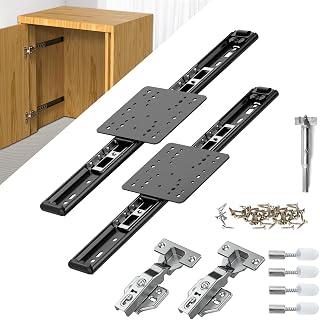
Best for: Buyers fitting concealed pocket-style hardware to a cabinet or wardrobe. The product name identifies a 12-inch kit supplied as a two-pack, making it a candidate when the project calls for paired slide hardware.
Choose this if you want doors to retract into cabinet or wardrobe space rather than travel across a long wall track. The supplied product information does not state a weight rating, door dimensions, or detailed installation requirements.
Limitation: Do not assume it meets a heavy-duty load requirement without confirming the manufacturer’s capacity and door-size specifications.
Lipshome Cabinet Pocket Door Hardware

Best for: Cabinet projects that specifically need inset pocket-door hardware. Its stated application is cabinet use, which makes it more relevant to a flipper-door search than a standard room-door track.
The product name describes it as heavy duty and intended for inset cabinet doors. However, the supplied listing information does not include a capacity, track length, door thickness range, or pack quantity. Compare those details with the planned door before selecting it.
Limitation: The “heavy duty” wording alone does not establish a specific load limit; verify capacity with the seller or manufacturer.
SMARTSTANDARD 6-Foot Bypass Door Kit

Best for: A larger doorway where two doors bypass one another on a track. The listed kit is 72 inches, or 6 feet, and includes a finger pull.
This is a different mechanism from cabinet flipper hardware. Choose it if the goal is a bypass sliding door rather than a cabinet door that pivots or disappears into a cabinet pocket.
Limitation: The supplied details do not state door weight capacity or supported door dimensions, so confirm those specifications before purchase.
FINOSEN 8-Foot Sliding Pocket Track

Best for: Projects using a full-size door between 36 and 48 inches wide. The listing describes an 8-foot aluminum, top-mount track and identifies the system as commercial grade and heavy duty.
The door is not included. Select this system for a top-mounted sliding-door installation, not for a cabinet flipper mechanism.
Limitation: The provided information does not give a door weight rating. Confirm allowable weight and installation requirements before relying on it for a heavy door.
Buying Guide: How to Choose Heavy-Duty Flipper Door Slides
Do you need pivot, pocket, or bypass hardware?
These terms describe different movements. A pivot kit lets a cabinet door swing and shift on hardware. A pocket system stores a door inside a cabinet or wall cavity. A bypass track lets one door slide past another. Match the mechanism to the space and movement you need before comparing material or track length.
What door weight and dimensions should you check?
Measure door height, width, and thickness, then compare them with the product’s listed limits. The Knape & Vogt kit specifies 30 pounds per door and a maximum 24-by-42-inch door. The other supplied product details do not establish load ratings, so request the manufacturer’s specifications rather than treating “heavy duty” as a measured capacity.
Is the kit made for a cabinet or a room door?
Cabinet pocket and pivot hardware is designed for furniture-scale applications. The 6-foot and 8-foot track products are larger sliding-door systems. A room-door track is not a substitute for inset cabinet hardware, and cabinet slides should not be assumed suitable for full-size doors.
What else should you verify before ordering?
- Whether the package includes hardware for one door or multiple doors.
- Whether the door is included; the FINOSEN listing says it is not.
- Required track length, mounting style, door thickness, and installation clearance.
- Weight capacity and any needed stops, pulls, or adjustment features.
Frequently Asked Questions
What is a flipper door slide?
It is hardware that lets a cabinet door move out of the opening, commonly by pivoting or retracting into a cabinet pocket. Confirm the intended motion because pocket, pivot, and bypass products are not interchangeable.
Which listed product gives a specific weight capacity?
The Knape & Vogt kit lists a 30-pound capacity per door and a maximum door size of 24 by 42 inches.
Are sliding barn-door tracks the same as cabinet flipper slides?
No. Full-size sliding tracks move doors along a wall or doorway. Cabinet flipper hardware is meant for a cabinet-scale door movement.
Should I buy hardware labeled heavy duty without a capacity figure?
Not without checking the manufacturer’s load and size limits. A descriptive label does not provide a measurable door-weight rating.