Gas on-demand water heaters provide instant hot water with high efficiency and compact footprints. They’re ideal for homes with multiple bathrooms, frequent hot water use, or limited closet space. The following five models cover natural gas and propane options, plus indoor and outdoor installations, helping you pick the best fit for your family’s hot-water needs and home setup.
The buyer’s guide table below highlights the key specs and best-use cases for quick comparison. Use it to narrow down which model aligns with your household demand, installation preferences, and fuel type.
| Product | Fuel & Location | Heating Capacity / Flow | Best For |
|---|---|---|---|
| APUS Natural Gas Tankless Water Heater | Natural Gas, Indoor | 95,000 BTU, 4.42 GPM | Homes needing steady 2 showers + sink during peak usage |
| ThermoMate CZ422NG | Natural Gas, Indoor | 113,000 BTU, up to 5 GPM | Multi-point hot water for bathrooms and kitchens |
| APUS Propane Tankless Water Heater | Propane, Indoor | 95,000 BTU, 4.42 GPM | Same 2–3 fixture scenario with propane fuel |
| Rheem RTG Series (Outdoor) | Natural Gas, Outdoor | 180,000 BTU, 8.4 GPM | Large households needing multiple showers simultaneously |
| VEVOR Tankless Water Heater (Propane) | Propane, Indoor | 100,000 BTU | Indoor propane setup with consistent temperature control |
APUS Natural Gas Tankless Water Heater

This natural-gas unit delivers 95,000 BTU with a 4.42 GPM flow, designed to support 2 showers plus a sink while maintaining stable temperatures. It uses precise sensors and smart CPU control to keep water temperature within ±1°F of the set point (95–140°F). The design emphasizes energy efficiency with an 0.81 UEF and high-efficiency heat exchangers. Best for households needing reliable hot water for multiple fixtures at once, indoors. A limitation is the 4.42 GPM ceiling, which may fall short if several high-flow fixtures operate together.
ThermoMate CZ422NG, Indoor Tankless Water Heater

ThermoMate CZ422NG provides up to 113,000 BTU and up to 5 GPM, aimed at delivering instant hot water for bathrooms and kitchens. The higher BTU capacity supports multiple fixtures with less temperature fluctuation under load. It’s a solid choice for medium-to-large homes with frequent hot water demand. Choose this if you need more headroom for simultaneous usage. A potential limitation is the larger installation footprint versus smaller 4–5 GPM models.
APUS Propane Tankless Water Heater

This propane model mirrors the natural-gas APUS unit with 95,000 BTU and 4.42 GPM, offering adjustable temperature from 95°F to 140°F. It’s well-suited for homes that run on propane and want the same steady temperature control and energy-efficient performance. Best for propane households with a similar fixture demand as the natural gas version. A caution: propane supply availability or line size may impact installation requirements and efficiency in some locales.
Rheem RTG Series Outdoor Gas Water Heater

Rheem RTG Series delivers 180,000 BTU and 8.4 GPM, designed for outdoor installation and large households. The non-condensing unit emphasizes on-demand heating for 3–4 showers under peak demand, with energy savings versus electric storage models. Best for big families or homes with high simultaneous hot-water needs, installed outdoors to simplify venting. A potential drawback is outdoor exposure requiring weatherproofing and appropriate clearances.
VEVOR Tankless Water Heater Propane
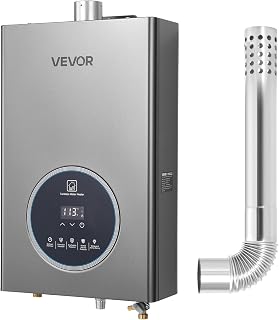
VEVOR’s propane model offers 100,000 BTU with indoor installation and smart temperature control. It provides reliable hot water for a whole house with a focus on straightforward operation and safety protections. Best for households seeking solid indoor propane performance with easy-to-read LED display and stable temperature control. A limitation is that its exact GPM is not specified beyond 100,000 BTU, so flow under high simultaneous demand should be considered carefully.
Buying Guide
What fuel type should you choose?
Natural gas units generally integrate smoothly with existing gas lines in many homes. Propane models are ideal if your area lacks natural gas service. Consider fuel availability, cost, and the efficiency rating when choosing between natural gas and propane.
Indoor vs. outdoor installation
Indoor models save space but require venting and adequate clearance. Outdoor units eliminate venting but need weatherproofing and protection from the elements. Choose based on your home’s exterior setup and local codes.
Sizing and fixture demand
Match the unit’s GPM rating and BTU to your peak simultaneous usage. A higher GPM supports more fixtures at once. If you frequently run multiple showers, kitchens, and laundry together, prefer models with higher BTU and flow.
Temperature control and safety features
Look for precise temperature control (±1°F if available) and sensors that prevent rapid temperature changes. Protection features such as anti-freeze and safe-start mechanisms improve reliability in cold climates.
Installation considerations
Verify venting requirements, electrical connections, and space constraints. Some models are easier to install on a budget, while others may require professional installation to ensure code compliance and proper gas supply sizing.
Energy efficiency and operating costs
Non-condensing units with high UEF (Uniform Energy Factor) tend to save energy. Compare the long-term operating cost implications of higher BTU output vs. efficiency ratings to find the best value for your home.
FAQ
- What is the benefit of a gas on-demand water heater over a traditional tank?
- Can I install a gas tankless water heater indoors?
- How do I know which GPM I need?
- Is outdoor installation safe for all climates?
- Do propane models differ significantly from natural gas ones?
- Are there maintenance tasks I should perform regularly?
Gas on-demand models heat water as it’s needed, reducing standby heat loss and typically saving energy compared to electric storage tanks.
Yes, many models are designed for indoor installation with proper venting and clearances. Always follow local codes and manufacturer instructions.
Estimate your peak hot-water demand by counting simultaneous fixtures and selecting a unit with at least that GPM rating or higher.
Outdoor units are weatherproofed but require protection from extreme temperatures and proper placement to ensure venting and access for maintenance.
Propane models perform similarly but depend on propane supply and line sizing. Ensure your home’s fuel infrastructure supports the chosen model.
Regular inspection of venting, gas connections, and combustion components is important. Follow the manufacturer’s maintenance schedule to maintain efficiency and safety.