Find the right eco-friendly wall panel heater to warm small rooms efficiently without breaking the bank. This guide highlights five well-matched options for American homes, from plug-in styles to hard-wired convectors. Each product is suited for compact spaces like bedrooms, home offices, and bathrooms, with clear reasons to choose or avoid. The table below summarizes key suitability details to help you compare at a glance.
| Product | Best For | Power | Approx. Area |
|---|---|---|---|
| EconoHome Wall Heater Panel with Thermostat | Small living spaces, quick warmth | 400W | Up to 120 sq ft |
| Envi Plug-in Electric Panel Wall Heater | Targeted spot heating, allergy-conscious homes | Low wattage (plug-in) | Rooms of various sizes |
| EconoHome Convection Wall Heater with Thermostat (Updated) | Rooms up to 120 sq ft, durable option | 400W | Up to 120 sq ft |
| EconoHome Convection Wall Heater with Thermostat (250W) | Smaller rooms, budget-conscious setups | 250W | Up to 120 sq ft |
| Amaze Ultraslim 250W | Bedrooms and bathrooms, paintable finish | 250W | Up to 80 sq ft |
EconoHome Wall Heater Panel with Thermostat

This 400-watt convection panel is designed for rooms around 120 square feet. It uses a thermostat to maintain a steady ambient temperature and includes a heat reflector. The unit is UL-2021 and RoHS compliant and can be hard-wired, which is suitable for dedicated wall installations in living spaces or home offices. The exterior stays warm enough to be felt but generally remains safe for adults. Overheat protection adds a safety layer. Best for: small living rooms or workspaces where a discreet wall panel is preferred over a bulky heater. Caution: hard-wiring may require professional installation.
Envi Plug-in Electric Panel Wall Heater

This plug-in model emphasizes safety and allergy considerations. It operates at a cool 90°F with a wall-sense safety sensor that cuts power if removed from the wall. Its fan-less design provides quiet, steady warmth ideal for bedrooms and nurseries. It can run continuously, which is useful for maintaining comfort in homes with children or pets. Best for: rooms where silent operation and a cool-touch surface matter most. Caution: low wattage means it isn’t a primary heater for very large spaces.
EconoHome Convection Wall Heater with Thermostat (Updated)

This updated 400W convection heater is designed for reliability and safety. The unit features a heat reflector, hard-wired compatibility, and triple-insulated construction in the upgraded version for enhanced electrical safety. It heats rooms up to 120 sq ft and is UL-2021 and RoHS compliant. Best for: users who want a durable, install-ready panel with solid safety features. Caution: hard-wiring may require professional installation; choose this if you prefer a sealed, paintable design that blends with decor.
EconoHome Convection Wall Heater with Thermostat (250W)
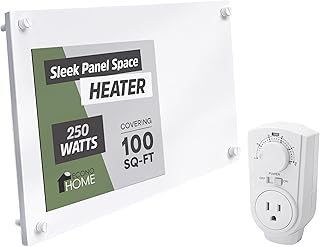
This 250W model is a compact option for smaller rooms while delivering the same convection-based warmth. It uses a panel design with a thermostat to maintain a comfortable temperature and is suited for modest spaces up to 120 sq ft. Best for: apartment bedrooms or home offices where a compact, efficient heater is needed. Caution: warmth output is lower than 400W models, so it may take longer to reach desired temperatures in larger rooms.
Amaze Ultraslim 250W Electric Wall Heater

The Amaze Ultraslim is a compact 250W panel heater designed for small spaces up to 80 square feet. It features ETL and UL 2021 compliance, triple insulation, and a paintable surface to match interior design. Best for: bedrooms or bathrooms where space is scarce and you want a discreet, paintable heater. Limitation: smaller room coverage means it may not suffice for larger living areas.
Buying Guide
- Room size and heat output: Match wattage to square footage. For rooms up to 120 sq ft, 250–400W panels are common. Larger spaces require higher output or supplemental heating.
- Installation style: Choose plug-in versus hard-wired based on your wall setup and electrical options. Plug-in units are easier to install; hard-wired units may offer steadier operation and cleaner aesthetics.
- Safety features: Look for overheat protection, cool-to-touch surfaces, and safety sensors, especially in homes with children or pets.
- Energy efficiency: Convection panels distribute heat with lower surface temperatures, reducing hot spots. Reflectors and insulation improve efficiency.
- Noise level: Fan-less designs are best for bedrooms and offices where silence matters.
- Finish and integration: If you want a paintable surface to blend with décor, verify the panel’s material and finish options.
FAQ
- Are wall panel heaters energy efficient? Yes. They typically use convection to distribute warm air and can have lower running costs than some traditional space heaters when used to heat only needed zones.
- Can these be installed myself? Plug-in models are straightforward. Hard-wired units may require a licensed electrician for electrical safety and compliance.
- Do they heat quickly? Convection panels warm rooms steadily. They may take a bit longer to reach peak warmth compared to radiant heaters, but they provide even temperatures.
- Is safety a concern in damp areas? Look for panels with proper insulation and moisture resistance ratings for bathrooms or kitchens, and avoid placing near water sources unless specified.
- Which is best for a small apartment bedroom? A compact 250–400W panel, such as the 250W Amaze Ultraslim or the 400W EconoHome, provides effective warmth without occupying much space.
- Do these require ongoing maintenance? Routine inspection of wiring and vents is advised. Most have safety shutoffs and do not require frequent servicing beyond periodic checks.