The best electric tankless water heater depends on how much hot water you need and what your home’s electrical system can support. The Rheem RTEX-24 is best suited to buyers seeking a higher-capacity whole-home option, while the Rheem 18kW model offers a lower-capacity alternative. For point-of-use sinks, compact 110V units are better suited to low-flow tasks—not showers. Compare the listed power, voltage, flow guidance, and installation requirements before choosing.
| Product | Best suited for | Key consideration |
|---|---|---|
| Rheem RTEX-24 | Higher-demand household use | Requires substantial electrical capacity |
| Rheem 18kW | Buyers comparing midrange output | Listed flow rate is up to 4.4 GPM |
| Orbek 14kW | One or two points of use | Requires a 240V circuit and specified wiring |
| xwdzswgs 110V 3000W | Low-flow sink use | Not suitable for showers |
| Generic 120V 3kW | Simple low-flow under-sink use | Not designed for multiple taps at once |
Rheem RTEX-24 24kW Tankless Water Heater
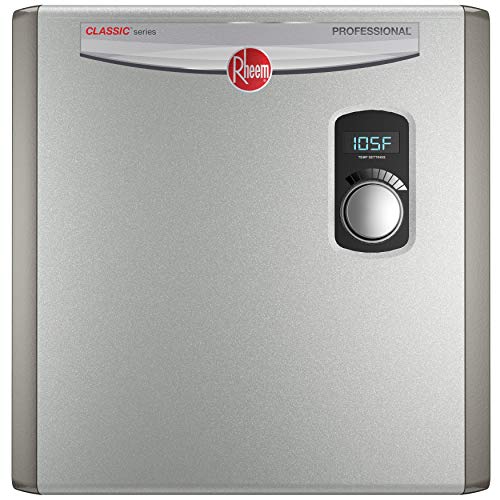
The Rheem RTEX-24 is the highest-capacity model in this selection and is intended for continuous hot-water use around the home. Its 24kW, 240V design has an adjustable digital temperature display, with settings from 80 to 140 degrees Fahrenheit in one-degree increments.
Best for: Buyers considering an electric tankless unit for broader household demand. The product information identifies it as a whole-home option, but actual output depends on groundwater temperature and required temperature rise.
Check before choosing: It requires three 40-amp double-pole breakers, and the product information recommends 200-amp household service. Confirm panel capacity and local installation requirements before purchase.
Rheem 18kW Electric Tankless Water Heater
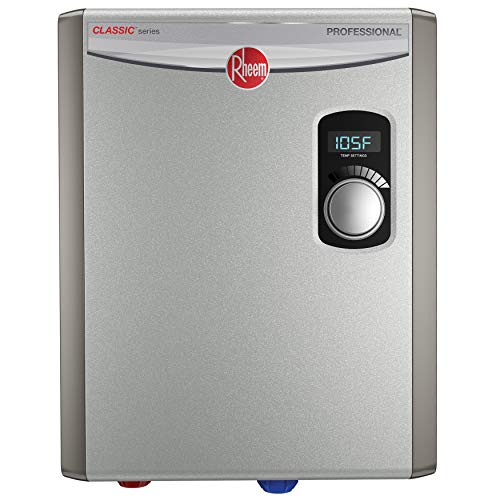
This Rheem model provides an 18kW, 240V option with a listed flow rate of up to 4.4 GPM. Its external digital thermostat has an LED display and one-degree adjustment accuracy. Self-modulation adjusts power to match hot-water demand, while the copper immersion heating elements are described as field-serviceable.
Best for: Shoppers who want a higher-output option than a small under-sink heater but are comparing a lower-rated unit than the 24kW Rheem. The listed maximum flow is a useful comparison point, not a guarantee for every installation.
Check before choosing: The product information does not provide the electrical breaker specifications here. Verify circuit requirements and expected flow against the manufacturer’s installation information and your home’s incoming water temperature.
Orbek 14kW 240V On-Demand Water Heater

The Orbek is a 14kW, 240V unit with a stated maximum flow of 3.38 GPM. The listing describes it as suitable for one to two points of use, such as a bathroom and kitchen. It specifies a 240V/60-amp two-pole breaker, one set of 6 AWG wires, and 1/2-inch NPT water connections.
Best for: Buyers seeking a mid-capacity point-of-use or limited multi-location setup who can meet the installation requirements. Its stated maximum flow makes it easier to compare with the higher-capacity Rheem models.
Check before choosing: The listing says the household breaker panel should have at least 150 amps of total capacity. Confirm this, the required wiring, and expected simultaneous hot-water demand before installation.
xwdzswgs 110V 3000W Under-Sink Heater

This compact 110V, 3000W heater has an LED display and is designed for point-of-use hot water. The listing states a temperature rise of 82 degrees Fahrenheit at 0.3 GPM and 131 degrees at 0.5 GPM. It also describes protections for leakage, dry boiling, overheating, and inactivity.
Best for: A low-flow kitchen or bathroom sink where a small, on-demand unit is appropriate. Choose it when compact size and 110V operation matter more than high flow.
Check before choosing: The listing explicitly says it is not suitable for showers, which normally require at least 1.8 GPM. Higher flow also means a lower outlet temperature according to the product information.
Generic 120V 3kW Mini Under-Sink Heater

This 120V, 3kW point-of-use model has a digital display and a control knob for on/off operation and temperature adjustment from 30 to 55 degrees Celsius. Listed protections include overheat, leakage, dry-heating, and over-pressure protection, plus IPX4 waterproofing and automatic fault diagnosis.
Best for: Buyers who prefer a straightforward temperature knob for a single low-flow fixture. The listing positions it for under-sink use and notes its compact design.
Check before choosing: It is not intended for showers or multiple taps at once. The listing also notes that water temperature depends on inlet temperature, flow, and heating capacity.
Buying Guide: How To Choose An Electric Tankless Water Heater
How much hot water do you need at once?
Estimate which fixtures may run simultaneously, then compare their combined demand with the heater’s output. A unit’s maximum listed GPM does not guarantee that flow at a comfortable temperature in every climate. Colder incoming water requires a greater temperature rise and can reduce usable flow.
Should you choose a whole-home or point-of-use model?
Higher-wattage 240V units are the more relevant category for broader household demand. Compact 110V and 120V, 3kW models are intended for low-flow use near a sink. Do not select a small under-sink heater for a shower when its listing says it is unsuitable.
What electrical requirements should you verify?
Check voltage, breaker size, household service capacity, and wiring requirements before buying. The Orbek listing gives specific circuit and wire details, while the RTEX-24 lists three 40-amp double-pole breakers and recommends 200-amp household service. Have a qualified professional assess the panel and installation conditions.
Which controls and safety features matter?
Digital temperature displays make settings easier to read, while a control knob may appeal to buyers who prefer physical adjustment. Compare listed protections, but treat them as product features—not a substitute for correct installation and following the manufacturer’s instructions.
Frequently Asked Questions
Can a 3kW tankless heater run a shower?
The two listed 3kW models say they are not suitable for showers. One listing notes that a shower normally requires at least 1.8 GPM.
Does a tankless electric heater provide unlimited hot water?
It can heat water on demand, but available flow and temperature depend on the unit’s capacity, incoming water temperature, and simultaneous use.
Is a 240V model automatically better than a 120V model?
No. A 240V model may suit greater demand, but it also has specific electrical requirements. A 120V point-of-use heater may be more appropriate for a single low-flow sink.
What should I check before buying?
Match the intended fixtures and flow needs to the heater’s specifications, then confirm voltage, circuit capacity, wiring, water connections, and installation requirements.