The best crash rail wall protection depends on the impact you need to manage: foam bumpers suit car doors and light contact, while a fillable steel barrier is designed to separate equipment from protected areas. These five options include garage padding, a commercial-style wall guard, a steel safety barrier, and a vinyl corner accessory. Match the product to the location, mounting surface, and likely impact before choosing.
| Product | Best suited for | Protection type |
|---|---|---|
| Guardian Steel Machine Guard | Equipment and hazard separation | Fillable barrier |
| AMPULLA Foam Wall Bumper | Garage car-door contact | Adhesive foam strip |
| Heavy-Duty Self-Adhesive Foam Bumpers | Flexible indoor or outdoor padding | Thick EVA foam |
| Rounded-Top Wall Guard | Continuous wall protection | Long wall guard |
| WG-8 Outside Corner | Protecting an outside corner | Vinyl corner piece |
Guardian Steel Machine Guard

This 4-foot-wide, 3-foot-high hollow steel barrier is intended to alert operators to hazards and help protect machines, walls, electrical boxes, and other areas from moving equipment. It is the strongest fit among these choices for a facility that needs a freestanding or mounted separation barrier rather than a foam strip attached directly to a wall.
Best for: Work areas exposed to forklifts, pallet jacks, or similar equipment. Its size and stated purpose make it more appropriate for equipment zones than ordinary garage door-ding protection.
Important limitation: The barrier ships hollow. The product information says it must be properly mounted and filled with concrete for maximum impact mitigation. It should not be treated as ready-to-use impact protection without suitable installation and ballast.
AMPULLA Thick Foam Wall Bumper

This foam protector is listed as a 79-by-8-inch strip with a 1/4-inch-thick surface. Its waterproof, diamond-textured surface is designed to help prevent scratches, and the strip can be cut into smaller pieces or shapes. That makes it a practical option for a homeowner who wants padding positioned where a car door or another object may touch a garage wall.
Best for: Targeted protection on garage walls where flexibility in placement and cutting matters. The listed high-density material and soft foam construction distinguish it from a rigid crash rail.
Important limitation: At 1/4 inch thick, this is a padded surface protector, not a steel barrier for forklift or heavy-equipment impacts. Confirm that the wall surface is suitable for the product’s installation method before applying it.
Heavy-Duty Self-Adhesive Foam Bumpers
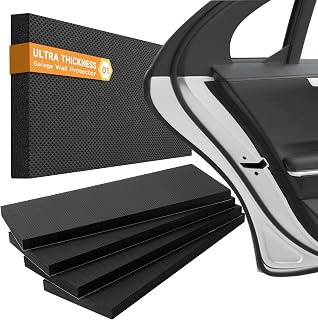
These bumpers are described as 0.8-inch-thick EVA foam with a diamond-textured surface. The listing says the strips can be cut for corners, curved walls, and pillars, and describes the construction as waterproof and UV-resistant for a stated temperature range of -20°F to 150°F. It also specifies adhesive installation without tools.
Best for: Buyers who want thicker, customizable padding for vehicle doors, furniture, or bike contact, including on varied wall shapes. Choose this over a thinner strip when padding depth is a priority.
Important limitation: The adhesive claim does not establish that every wall finish will hold equally well. Check the surface and installation instructions first, and do not substitute foam padding for a rated industrial barrier where vehicle or machinery impacts are a concern.
Rounded-Top 12-Foot Wall Guard

This gray wall guard is listed as 4 inches high and 12 feet long, making it a better match for continuous coverage along a wall than for a small, isolated impact point. Its rounded top edge is designed to coordinate with the BR-400 Series handrails. The product information also notes versions with horizontal grooves or spacers for installation extended from the wall.
Best for: Buyers planning a long wall-protection run and seeking a coordinated look with compatible handrails. Consider it when a finished wall guard is more suitable than exposed foam strips.
Important limitation: The provided features do not specify impact ratings, material, or installation hardware. Check those details and verify the dimensions and compatibility needed for the intended project.
WG-8 Vinyl Outside Corner

This accessory is an outside-corner component for WG-8, made of vinyl and listed in Chinchilla color. Its role is more specific than a full wall guard: it is intended to protect an outside corner as part of a compatible wall-protection setup.
Best for: Buyers completing a WG-8 wall-guard installation who need a matching outside-corner piece. Its specialized shape may help address a vulnerable corner where a straight strip alone would not cover the edge.
Important limitation: This is a corner accessory, not a standalone length of crash rail. Confirm that the WG-8 system and color are appropriate for the project before ordering.
Buying Guide: How to Choose Crash Rail Wall Protection
What kind of impact are you trying to prevent?
For car-door marks, furniture bumps, or bike contact, foam strips provide a cushioned surface at likely contact points. For moving equipment near walls, machines, or electrical boxes, a steel barrier is a different category of protection. Do not assume a wall bumper offers the same separation or impact control as a properly installed barrier.
Do you need a strip, a long guard, or a barrier?
Choose a cut-to-fit foam strip for targeted coverage, a long wall guard for a continuous run, and a corner accessory for an exposed outside edge. A fillable barrier suits equipment zones where the goal is to create a physical boundary. Compare product dimensions with the area that needs protection before purchasing.
Will the mounting method work on your wall?
Adhesive protectors depend on suitable surface preparation and adhesion. A barrier may require mounting and concrete filling, while a wall guard may need a specific installation approach. Review the product’s instructions and confirm surface compatibility, hardware requirements, and any system components separately.
How much coverage do you need?
Measure the wall, corner, or equipment zone and identify the height where contact is likely. Cuttable foam can be shaped to fit smaller locations, while a 12-foot guard covers a longer stretch. For a corner system, check that the accessory matches the main guard model.
Frequently Asked Questions
Is foam wall protection the same as a crash rail?
No. Foam protectors cushion lighter contact and help reduce scratches. A crash barrier or rail is intended for a different level or type of protection, so select it according to the expected impact and installation requirements.
Which option is best for a garage car door?
The AMPULLA strip or the thicker self-adhesive EVA bumpers are the most directly suited to garage car-door contact. Compare their thickness, coverage, and wall-surface requirements.
Can the Guardian barrier be used while hollow?
The product information says it ships hollow and must be properly mounted and filled with concrete for maximum impact mitigation. Follow its installation requirements for the intended protection.
Can the WG-8 corner piece protect a whole wall?
No. It is an outside-corner accessory, not a full-length wall guard. Use it with the compatible WG-8 system if corner coverage is needed.
What should I measure before choosing a wall guard?
Measure the length and height of the area, note corners and obstacles, and identify the likely contact zone. Also check mounting needs and compatibility with any existing wall-guard or handrail system.