For a concrete table or an epoxy-coated tabletop, choose a product made for smooth, clear surface coatings rather than a garage-floor coating. Promise Epoxy is a practical pick for table and bar-top finishes, Superclear is aimed at countertop coatings, and TAKIMO suits smaller creative pours and river-table work. The ANE and McKinnon kits are primarily floor products, so check their directions carefully before considering them for furniture.
| Product | Best suited for | Key distinction |
|---|---|---|
| Promise Epoxy Table Top Kit | Table and bar-top coatings | 1:1 mix and self-leveling finish |
| Superclear Countertop Epoxy | Countertop-style coatings | Clear or marble appearance |
| TAKIMO Resin Kit | Small pours and resin art | 1:1 mix and UV-resistance claim |
| ANE Self-Leveling Epoxy | Concrete coating applications | Light gray floor-oriented kit |
| McKinnon Concrete Epoxy Kit | Garage floors | Large, 20-gallon floor kit |
Promise Epoxy Table Top Kit
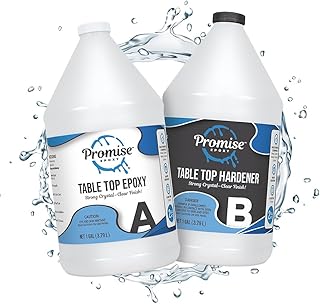
Best for: DIYers coating a table, bar top, serving board, or similar surface. This two-gallon kit is specifically presented for table-top and bar-top coatings, making it a more direct match for furniture projects than garage-floor epoxies.
The listed 1:1 mixing ratio is intended to make measuring straightforward, and the self-leveling formula is designed to create a high-gloss finish. The product information says it complies with 21 CFR 175.300 for qualifying food-contact surfaces when measured, mixed, and fully cured according to directions. This is not a blanket FDA certification.
Limitation: It is not intended for cutting surfaces, cookware, or direct high-heat exposure. Follow the product directions for mixing and curing before food contact.
Superclear Countertop Epoxy

Best for: Projects where a countertop-style coating or a clear or marble look is wanted. The listed 1.5-gallon kit is described as a countertop epoxy, making it a relevant option for a concrete table that needs a coating intended for broad, flat surfaces.
Choose this if appearance is a priority and you want a clear or marble-style finish. The product name describes it as food-safe, but buyers should read the manufacturer’s instructions and claims carefully rather than assume it is suitable for every food-contact use.
Limitation: The supplied product details do not state a mixing ratio, pour depth, or cure time. Confirm these requirements before planning a project, especially over porous concrete.
TAKIMO UV-Resistant Resin Kit

Best for: Smaller decorative pours, resin art, and DIYers who want a clear, glossy coating. The 68-ounce kit is one of several listed sizes, and the product features a 1:1 mixing ratio by volume. The manufacturer also describes it as suitable for table tops, bar tops, and river tables.
Its listed UV-resistance claim may make it worth comparing for projects exposed to light. The formula is described as including defoamers, and the product recommends pouring in layers of one-quarter inch for a bubble-free finish. That layering instruction is important when planning the quantity and schedule for a project.
Limitation: The supplied details do not identify it as a concrete-specific coating. Prepare and test the concrete surface as directed, and do not assume the resin can be poured in a single thick layer.
ANE Self-Leveling Epoxy Kit

Best for: Buyers comparing coatings for concrete who are willing to verify furniture suitability before applying. The product is described as an industrial-grade, self-leveling epoxy for concrete floors and countertops, and its light-gray color may suit projects where a tinted finish is acceptable.
It is less directly tailored to table-top work than the clear tabletop kits above. Its concrete and countertop positioning makes it more relevant to a concrete surface than a general resin-art product, but the listing does not provide detailed table-specific application instructions.
Limitation: This is primarily presented as a floor epoxy. Confirm that the manufacturer approves it for the intended table use, and check the listed application and curing requirements before buying.
McKinnon Concrete Epoxy Kit

Best for: Large garage-floor projects, not ordinary concrete tabletops. This 20-gallon kit is described as a 100% solids garage floor and concrete epoxy kit, so it is included as a concrete-coating comparison rather than a top table-resin recommendation.
Choose it only if the project is actually a floor or if the manufacturer confirms that the formulation and application instructions suit the intended furniture surface. The large kit size also makes it a poor fit for many small table projects.
Limitation: Its stated use is garage floors and concrete coating, not tabletop finishing. Do not assume that a floor epoxy will provide the clear decorative finish or food-contact suitability expected from a table-top resin.
Buying Guide: Choosing Epoxy For A Concrete Table
Is the epoxy made for furniture or floors?
Start with the intended use on the product label. Tabletop and countertop formulas are more directly suited to furniture finishing. Garage-floor products are designed and marketed for floor applications, so use them on a table only if the manufacturer explicitly supports that use.
Will the coating bond to the concrete?
Concrete is porous and may contain dust, sealers, moisture, or uneven areas that interfere with a coating. Follow the resin maker’s surface-preparation directions. Check whether a primer, test patch, or sealing coat is recommended. Do not assume that “for concrete” means every concrete surface is ready to coat.
How much resin and what pour depth do you need?
Estimate the tabletop’s area and the coating thickness before selecting kit size. Follow the stated layer-depth limits: TAKIMO, for example, recommends one-quarter-inch layers. A kit intended for large floor areas may be impractical for a small table, while a small craft kit may not cover a broad surface.
What finish and use does the table require?
Choose clear resin for a visible concrete or decorative surface, or a colored formula if the product’s stated finish matches the design. For food-contact claims, read the exact conditions and cure instructions. A food-contact-compliant coating is not automatically suitable for cutting, cookware, or hot dishes.
Frequently Asked Questions
Can I use garage floor epoxy on a concrete table?
Only if the manufacturer confirms it is suitable for that use. Floor kits are not automatically tabletop coatings and may not provide the intended finish or use characteristics.
Which listed option is most directly intended for tables?
Promise Epoxy is specifically described for table tops and bar tops. TAKIMO also lists table-top projects, while Superclear is presented as a countertop coating.
Does epoxy make a concrete table food safe?
Not by default. Follow the product’s exact food-contact statements, mixing instructions, and cure requirements. Promise states compliance for qualifying surfaces under specified conditions, but excludes cutting surfaces, cookware, and direct high heat.
Should concrete be sealed before applying resin?
Follow the epoxy manufacturer’s preparation instructions. Concrete porosity and surface condition can affect the coating, so determine whether sealing or a test application is recommended before coating the full table.