The best RV dehumidifier with a drain hose depends on how much moisture you need to remove, the available space, and whether quiet operation matters. The Levoair is a practical pick for a compact RV area with a larger tank, while Litever is designed for very small enclosed spaces. For a small-space model with a listed humidistat, consider AEOCKY; for cold-weather use, compare the rotary desiccant option. These are compact appliances, so check the manufacturer’s stated coverage and operating conditions before choosing one for an entire RV.
| Product | Best For | Notable Detail |
|---|---|---|
| Levoair | General small-RV use | 5-foot hose and 68-ounce tank |
| AEOCKY Thermoelectric | Focused small spaces | 24-hour timer and humidistat |
| Litever | Closets and compact areas | 4-foot hose; stated space under 108 sq. ft. |
| AEOCKY Rotary Desiccant | Cooler conditions | Desiccant technology designed to avoid frost |
| WoEleLigt | Selectable operating modes | High-power and sleep modes |
Levoair 68-Ounce Dehumidifier

The Levoair is best for RV owners who want a compact unit with both manual emptying and continuous drainage. Its listed 68-ounce tank can also collect water when the drain hose is not connected. The supplied 5-foot hose is intended to let collected water drain without repeated tank emptying.
The product listing states a maximum extraction of 35 ounces per day under specific warm, humid test conditions and describes coverage up to 650 square feet. It also lists automatic shutoff when the tank is full and memory that restores the previous setting after the tank is replaced. Choose this model if those operating details fit your setup.
Limitation: The listing says dehumidification becomes less effective below 59°F or below 35% humidity, so it may not suit cold or relatively dry conditions.
AEOCKY Small Thermoelectric Dehumidifier
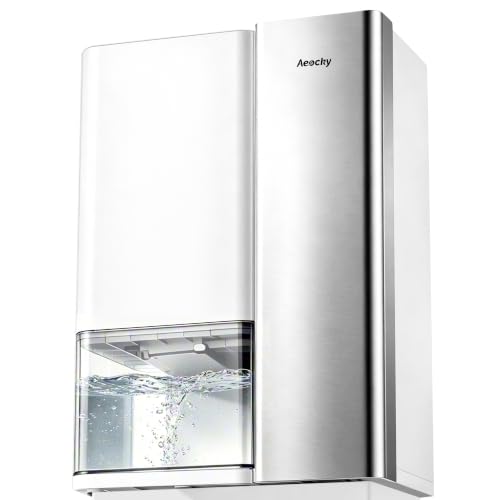
This AEOCKY model is best for a localized RV area, such as a bathroom or closet, rather than a large open interior. Its listing describes next-generation thermoelectric technology, a 64-ounce tank, a drain hose, a 24-hour timer, and an intelligent humidistat. Those controls make it a candidate for buyers who want scheduled operation and humidity-based management in a small enclosed space.
The product information gives a maximum daily capacity of 41 ounces at 95°F and 95% relative humidity. That is a stated test condition, not a guaranteed everyday output. Choose it when quiet, compact use and controls are priorities.
Limitation: The listing explicitly says the unit is not suitable for basements and is designed for small spaces; its extraction figures should not be treated as proof of whole-RV coverage.
Litever Compact Dehumidifier

Litever is best for a small, enclosed RV area where a low stated coverage limit is appropriate. The manufacturer describes it as effective for spaces under 108 square feet and lists extraction up to 12 ounces per day at 86°F and 80% relative humidity. Its 4-foot silicone drain hose is designed for continuous drainage, and an external transformer supplies 9V DC to the unit body.
Choose this model if the target is a compact pantry, wardrobe, or similar area and the stated capacity matches the moisture problem. The listing also says the hose can reduce the need to remove and empty the tank frequently.
Limitation: Its stated coverage and daily extraction are modest compared with larger-listed models, so it is not the best match for a larger RV interior or substantial moisture.
AEOCKY Rotary Desiccant Dehumidifier

This AEOCKY model is best for RV owners comparing dehumidification options for cooler conditions. Unlike the thermoelectric models listed here, it uses rotary desiccant technology, and the product name describes it as a never-frost unit. The listing also specifies an 85-ounce tank, a drain hose, an intelligent humidistat, and coverage up to 1,000 square feet.
Its product information says the desiccant core absorbs water vapor and releases it when heated. It also warns that warmth and a slight scent may occur, particularly during first use or after storage. Consider this model when temperature performance is an important selection factor.
Limitation: The listing recommends placing it farther away if the warmth is noticeable and ventilating the space if sensitive to the scent. It is described for compact areas, not large basements.
WoEleLigt 98-Ounce Dehumidifier

WoEleLigt is best for buyers who want to switch between higher-output operation and quieter nighttime use. The listing describes dual-core semiconductor technology, high-power and sleep modes, a 98-ounce tank, and dual drainage: manual emptying or a connected hose. Sleep mode is listed as operating below 30 dB, and automatic shutoff is described for a full or improperly placed tank.
The manufacturer presents this model for closed rooms and small spaces, including RVs, and gives coverage up to 1,000 square feet. Choose it if selectable modes and a larger listed tank are useful for your routine.
Limitation: The listing recommends closed-room use for performance. Its coverage claim does not establish that it will dehumidify every area of an open RV evenly.
Buying Guide: Choosing an RV Dehumidifier With a Drain Hose
How much space needs dehumidifying?
Match the unit’s stated use to the area where it will operate. A compact model may work better for a closet or bathroom than for a connected, open RV living area. Coverage figures vary by listing and are not directly comparable unless test conditions are the same. Daily extraction figures also depend on temperature and humidity.
Is continuous drainage practical in your RV?
Check hose length, the location of the drain, and whether gravity can carry water to that location. The listed hoses range from 4 to 5 feet for the models described here. Confirm that the hose can be routed without kinks and that its outlet can drain safely. A hose does not remove the need to set up and monitor drainage appropriately.
Should you choose thermoelectric or desiccant?
The thermoelectric models emphasize compact, quiet small-space use. The rotary desiccant model is a different technology and is presented as avoiding frost, but its listing notes possible warmth and scent. Consider the RV’s typical temperature, the target space, and your sensitivity to sound or heat.
Which convenience features matter?
A larger tank can reduce manual emptying when the hose is not used. Automatic shutoff can help prevent overflow when a tank fills, while timers and humidistats add control. Prioritize features that match how often the RV is occupied and whether the unit will run while you sleep or are away.
Frequently Asked Questions
Can an RV dehumidifier drain continuously?
Yes, the models described here list drain hoses for continuous drainage. Proper hose placement and a suitable drainage point are still necessary.
Will a small dehumidifier control moisture throughout an entire RV?
Not necessarily. Performance depends on the unit, temperature, humidity, and whether air can circulate between rooms. A model intended for a small enclosed space may not cover an open RV evenly.
Does a drain hose mean the water tank is unnecessary?
No. These products also have collection tanks. The tank can be used when the hose is disconnected, but follow the product instructions for drainage and tank placement.
Which listed model is intended for cooler conditions?
The AEOCKY rotary desiccant model is described as never-frost. The Levoair listing, by contrast, warns that dehumidification is less effective below 59°F.