The best sink water filter system depends on which contaminants you want to reduce and how much installation work you can manage. Waterdrop 10UA is best for a straightforward cold-water connection, while the TSA offers three filtration stages without reducing TDS. For a separate faucet and ultrafiltration, consider the Waterdrop TSU; for reverse osmosis with remineralization, the iSpring RCC7AK-BN is a different type of system. Epic Smart Shield MAX is designed for broader contaminant reduction, according to its product information.
| System | Best suited for | Key distinction |
|---|---|---|
| Waterdrop 10UA | Simple under-sink installation | Twist-and-lock filter design |
| Waterdrop TSA | Multi-stage filtration on a budget of space | Three filters; does not reduce TDS |
| iSpring RCC7AK-BN | Reverse osmosis and remineralization | Six-stage RO system |
| Epic Smart Shield MAX | Broad contaminant-reduction claims | Triple-layer filtration |
| Waterdrop TSU | Ultrafiltration without wastewater | 0.01-micron membrane and separate faucet |
Waterdrop 10UA Under-Sink Filter

The Waterdrop 10UA is best for households that want an under-sink filter with a twist-and-lock cartridge and connections designed for common U.S. cold-water lines. The product is NSF/ANSI 42 certified. Its push-to-connect fittings and included 3/8-inch line are intended to simplify installation, and a converter fitting supports connection to 1/2-inch and 3/8-inch cold-water pipes and faucets.
The manufacturer describes cartridge replacement as a quick twist-and-lock process. This model is specifically designed for municipal tap water, not well water, and must be connected to cold water only. Choose it if you want a direct under-sink setup; avoid it if your source is well water or you need hot-water filtration.
Waterdrop TSA 8-Layer Filter System

The TSA is best for buyers who want a three-filter system for municipal tap water and do not need TDS reduction. Its listed filtration targets include PFAS, PFOA/PFOS, residual chlorine, fluoride, silt, rust, and cysts. The product description says its CT filter has passed IAPMO certification to reduce residual chlorine and improve taste. It also says the system retains beneficial minerals.
It connects to standard under-sink cold-water setups with 1/2-inch or 3/8-inch female NPT threads. No additional faucet is included, and the system is not suitable for hot water. For well water, the listing recommends pre-filtration. Choose this model for multiple filter stages, but not if TDS reduction is a priority.
iSpring RCC7AK-BN Reverse Osmosis System
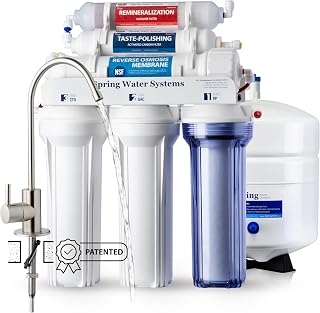
The iSpring RCC7AK-BN is best for buyers specifically seeking reverse osmosis and a remineralization stage. It is a six-stage system rated at 75 gallons per day in the product name. Its alkaline stage adds minerals and is described as supporting balanced pH. The patented top-mounted fastener is designed to make faucet installation easier from above the countertop.
A transparent first-stage housing lets users view visible contaminant buildup, according to the product features. This system is a more involved choice than a basic inline filter, so compare its multi-stage design with your available under-sink space and installation preferences. Select it when RO and remineralization are desired; it may be more system than needed for buyers seeking only improved taste.
Epic Smart Shield MAX Under-Sink System

The Epic Smart Shield MAX is best for buyers comparing systems by the breadth of their stated contaminant-reduction claims. Its triple-layer CoreXchange design uses an external nano-fiber layer, an internal carbon-fiber block, and granular filter resin. The product information says the layers target microplastics and pathogens, chemicals and heavy metals, and fluoride and arsenic, respectively.
Epic states that the system is independently certified to remove up to 99.99% of more than 70 contaminants from tap water, and lists a 750-gallon capacity. The filters are described as made in the USA. Those claims are product-specific; check the exact contaminant list and certification details to determine whether they address your water concerns. The supplied details do not specify connection requirements.
Waterdrop TSU 0.01-Micron Ultrafiltration System

The TSU is best for buyers who want ultrafiltration while retaining minerals and avoiding wastewater, as described in the product listing. Its three-stage system includes a 0.01-micron membrane and is listed as reducing more than 30 substances, including chlorine, PFAS, taste, odor, and heavy metals. It does not reduce TDS and does not require power. The maximum listed flow is 1.05 gallons per minute.
This system is designed for municipal tap water and cold-water connections. It includes a separate faucet that requires countertop drilling, so it is less suitable for buyers who do not want to drill. The listing says it is not suitable for well water or hot water.
Buying Guide: How To Choose A Sink Water Filter
Which filtration type fits your water goals?
Start with a recent water-quality report or a test of your water, then match the system’s stated reduction claims to the substances you want to address. Carbon-style systems such as the Waterdrop 10UA and TSA emphasize chlorine, taste, and other listed targets. The TSU uses ultrafiltration, while the iSpring is a reverse osmosis system with remineralization. Do not assume that one filter removes every contaminant.
Do you want to reduce TDS?
TDS measures dissolved substances collectively; it does not identify which substances are present. The TSA and TSU product details explicitly say they do not reduce TDS. If TDS reduction is important, compare reverse osmosis options and review the system’s specific performance information.
Will the system fit your plumbing and counter?
Check cold-water requirements, pipe sizes, faucet threads, and available cabinet space before buying. The 10UA lists a 3/8-inch line and converter fitting; the TSA describes 1/2-inch and 3/8-inch female NPT connections. The TSU requires a separate faucet and countertop drilling. Confirm connection details for any model not fully specified in its product information.
What should you check about replacement filters?
Confirm compatible replacement cartridge identifiers and the stated capacity or replacement schedule before choosing a system. Filter availability and maintenance needs affect long-term convenience. Follow the manufacturer’s instructions, and replace cartridges as directed rather than relying only on taste or appearance.
Frequently Asked Questions
Do under-sink water filters reduce TDS?
Not all of them. The Waterdrop TSA and TSU listings say they do not reduce TDS. Check each model’s specifications if TDS reduction is a requirement.
Can these systems be used with well water?
Several listed Waterdrop systems are designed for municipal tap water, not well water. The TSA listing recommends pre-filtration for well water. Check the manufacturer’s guidance before connecting any filter to a private well.
Do under-sink filters need electricity?
The Waterdrop TSU listing says it requires no power. Power needs for the other listed systems are not specified in the provided product details.
Does the Waterdrop TSU include a faucet?
Yes. Its listing says it includes a separate faucet, but installation requires countertop drilling.
Is reverse osmosis the same as ultrafiltration?
No. The iSpring RCC7AK-BN is a reverse osmosis system, while the Waterdrop TSU uses ultrafiltration. Their listed filtration designs and TDS claims differ, so compare specifications against your water needs.