The best gable vent attic fan depends on the attic’s size, the airflow you need, and whether you want automatic temperature control. The iLiving model is best for larger attics based on its listed coverage, while the Windigaga offers remote control and multiple speeds. The BINGLUX is a plug-and-play option with a long power cord. Compare the listed specifications below, and confirm that each fan’s dimensions and installation requirements suit your existing gable vent.
| Product | Best for | Listed airflow |
|---|---|---|
| Windigaga 15-inch fan | Remote control and adjustable operation | 1,800 CFM |
| BINGLUX 15-inch fan | Plug-and-play setup | 1,650 CFM |
| ZMRTDWO 10-inch shutter fan | Shutter-style ventilation | 1,400 CFM |
| Criditpid 12-inch shutter fan | Adjustable speed and thermostat | 970 CFM |
| iLiving ILG8G14-12T | Listed coverage up to 3,400 square feet | 2,339 CFM |
Windigaga 15-Inch Fan With Remote

Best for: Homeowners who want high listed airflow with convenient controls. This 15-inch fan is rated at up to 1,800 CFM and has a 70-watt motor. Its thermostat can be adjusted from 32°F to 140°F, and the fan offers three speeds and an 18-hour timer.
The included remote controls power, speed, timer, and temperature modes from up to 65 feet away. Choose this model if you value remote operation and adjustable settings without entering the attic. The product description does not list a recommended attic area, so check the airflow requirements for your space before selecting it.
BINGLUX 15-Inch Plug-And-Play Fan

Best for: Buyers prioritizing a stated plug-and-play design and a 20-foot power cord. The fan is listed at 1,650 CFM and is described as suitable for spaces up to 2,500 square feet. Its PSC motor is presented as a quiet, reliable design, and the fan includes a thermostat.
It may be a better fit when a long cord can simplify placement. Avoid assuming that “plug and play” eliminates every installation step: verify outlet access, mounting dimensions, and the manufacturer’s setup instructions. The provided details do not specify remote control or multiple fan speeds.
ZMRTDWO 10-Inch Shutter Exhaust Fan

Best for: Buyers who want a compact fan with an automatic shutter. It lists airflow up to 1,400 CFM and an IPX4 water-resistance rating. The shutters open when the fan runs and close when it is off, helping block dust, insects, and rain according to the product description.
This model is described for several applications, including garages, greenhouses, sheds, and gable ventilation. Choose it if the shutter design and moisture protection match your installation. Its 10-inch size differs from the 15-inch options, so confirm the opening and mounting arrangement. The listed features do not mention a thermostat.
Criditpid 12-Inch Fan With Controller

Best for: Buyers looking for a smaller shutter-style fan with speed and temperature adjustment. The product name lists 970 CFM, a speed controller, and an adjustable thermostat. It is described as a wall-mounted ventilation fan for uses that include attics, garages, and gable ventilation.
Choose this model if adjustable operation matters more than the higher airflow figures of the 15-inch options. Its listed 970 CFM is lower than the other fans in this comparison. The supplied product details do not provide an attic coverage figure, so do not assume it suits a particular square footage without checking requirements.
iLiving Automatic Gable Mount Ventilator
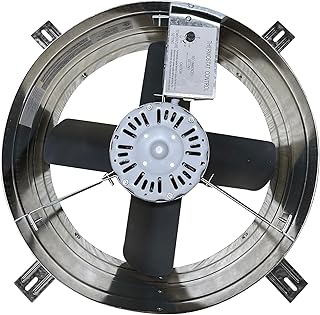
Best for: Buyers comparing fans by stated attic coverage. This gable-mount ventilator lists 2,339 CFM and coverage up to 3,400 square feet. It has an adjustable built-in thermostat and a single-speed design. Listed electrical details include 2.85 amps, 120 volts, 230 watts, and a 1/8-horsepower motor.
It is the strongest listed airflow option in this selection and may suit a larger attic when the stated coverage matches the space. Its single speed offers less speed adjustment than models with controllers. Confirm the mounting dimensions and ventilation plan before purchase.
Buying Guide: How To Choose A Gable Vent Attic Fan
How much airflow does an attic need?
Compare the fan’s CFM rating with the attic’s size and ventilation requirements. CFM means cubic feet of air moved per minute, but a higher number alone does not guarantee a suitable installation. Consider the existing intake ventilation and follow applicable building guidance or professional advice. Coverage claims differ by product and should be treated as manufacturer-listed figures, not universal guarantees.
Should you choose a thermostat or manual controls?
A thermostat can switch a fan on or off based on temperature, reducing the need for manual operation. Remote controls and timers add convenience, while a speed controller offers more control over airflow. If you want straightforward operation, compare whether temperature adjustment, speed settings, and remote functions are actually listed for the model.
What should you check before installation?
Measure the gable opening and compare it with the fan’s mounting requirements. Check whether the product is designed for your installation style, whether an outlet is available, and whether its cord or wiring arrangement suits the location. Also consider noise, shutters, and exposure to moisture. A shutter fan’s features may be useful, but confirm it fits the intended gable installation.
Frequently Asked Questions
What does CFM mean on an attic fan?
CFM means cubic feet per minute and describes the volume of air a fan moves. Compare CFM alongside attic size, ventilation needs, and the fan’s installation requirements.
Is a thermostat useful on a gable vent fan?
A thermostat can automatically operate the fan in response to temperature settings. It is useful for buyers who prefer automatic operation over switching the fan manually.
Can a shutter exhaust fan work in a gable vent?
Some listed products describe gable ventilation among their applications. Confirm the specific model’s mounting design and dimensions before choosing it for a gable opening.
Is the highest-CFM fan always the best choice?
No. The appropriate fan depends on the attic’s size, ventilation setup, opening dimensions, and desired controls. Match the listed airflow to the project rather than selecting by CFM alone.