The best reverse osmosis water system depends on your space, installation preference, and taste needs. The iSpring RCC7AK-BN is best for under-sink buyers who want remineralization; the Waterdrop G3P600 suits those seeking a high-capacity tankless system with monitoring. For countertop use, the DREO offers auto-fill and self-cleaning, while the Waterdrop C2SL adds minerals and a glass pitcher. The APEC ROES-50 is a straightforward under-sink option with five filtration stages.
| System | Best For | Key Feature |
|---|---|---|
| iSpring RCC7AK-BN | Mineral-enhanced under-sink water | Alkaline stage and top-mounted faucet design |
| Waterdrop G3P600 | High-capacity tankless filtration | 600 GPD and smart display faucet |
| DREO Countertop RO | Countertop convenience | TDS monitoring and self-cleaning |
| APEC ROES-50 | DIY-friendly under-sink setup | Five-stage filtration, 50 GPD |
| Waterdrop C2SL | Countertop mineralized water | Auto-fill glass pitcher, no plumbing |
iSpring RCC7AK-BN: Best Under-Sink System With Minerals
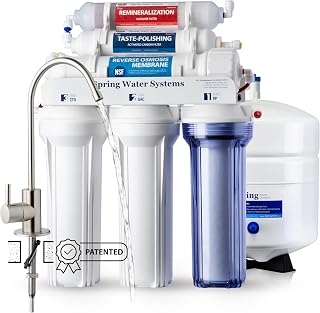
This six-stage system is best for households that want under-sink reverse osmosis filtration followed by mineral addition. Its alkaline stage adds minerals and is designed to provide a balanced pH and taste. The system is rated at 75 gallons per day.
The top-mounted fastener is intended to make countertop faucet installation easier from above the sink. A transparent first-stage housing also lets users see buildup as the filter collects particles. These features make it a practical pick for buyers who value installation access and a visible filter housing.
Consideration: This is an under-sink system, so it is not the right choice for someone who wants a portable, no-plumbing countertop unit.
Waterdrop G3P600: Best High-Capacity Tankless System

The Waterdrop G3P600 is best for buyers seeking a tankless under-sink system with a listed production capacity of 600 gallons per day. Its eight-stage filtration is described as reducing TDS and a range of substances, including PFAS, fluoride, arsenic, and chlorine. The manufacturer lists NSF/ANSI 58 certification for TDS reduction, NSF/ANSI 372 for lead-free materials, and NSF 42 testing and certification for chlorine, taste, and odor reduction.
A smart display faucet provides TDS readings and filter-life tracking. That makes this model better for users who want filtration information and replacement reminders at the tap.
Consideration: Buyers should confirm the installation space and setup requirements before choosing an under-sink tankless design.
DREO Countertop RO: Best for Automated Dispensing

This DREO countertop system is best for people who prefer not to install an under-sink filter. Its seven-in-one filtration system is described as filtering contaminants including PFOA, PFOS, chlorine, and fluoride. The product information says it was tested by SGS against NSF/ANSI 58 standards.
Real-time TDS readings for raw and filtered water and filter-life reminders help users monitor the system. An auto-fill sensor supports hands-free refills, while the self-cleaning function flushes internal tubes. Choose this model if those automated features matter in a countertop setup.
Consideration: As a countertop unit, it occupies counter space; measure the intended location before buying.
APEC ROES-50: Best DIY-Friendly Under-Sink Pick

The APEC ROES-50 is best for buyers looking for a five-stage under-sink system with a stated 50-gallon-per-day capacity. Its listed reduction targets include arsenic, chlorine, lead, fluoride, heavy metals, PFAs, and microplastics. The manufacturer also describes the filters as large-capacity and long-lasting.
Quick-connect fittings and colored tubing are intended to simplify setup and maintenance. This makes the ROES-50 a useful comparison for homeowners who want a conventional under-sink layout and plan to handle installation or servicing themselves.
Consideration: Its rated capacity is lower than the 75 GPD iSpring and 600 GPD Waterdrop tankless systems listed here.
Waterdrop C2SL: Best Countertop System With a Glass Pitcher

The Waterdrop C2SL is best for renters or households that want countertop reverse osmosis without plumbing, drilling, or a faucet connection. Its seven-stage system uses a 0.0001-micron RO membrane. SGS laboratory testing cited by the manufacturer reports reductions for PFOA, PFOS, microplastics, lead, chlorine, and fluoride.
A mineral filter adds calcium, magnesium, potassium, and sodium for a more balanced taste. The unit fills a detachable 40-ounce glass pitcher from its 108-ounce feed-water tank, making it convenient for refrigerator storage, cooking, and serving.
Consideration: Users must refill the feed-water tank, so it may be less convenient than a system connected to a household water line.
Buying Guide: How to Choose a Reverse Osmosis Water System
Should you choose countertop or under-sink?
Choose a countertop system if you want to avoid plumbing changes or need a movable option. The DREO and Waterdrop C2SL are countertop models; the C2SL specifically requires no plumbing, drilling, or faucet connection. Under-sink models such as the iSpring and APEC connect to a kitchen water setup, so check installation needs and available cabinet space.
How much capacity do you need?
Compare stated daily capacity when several people will use the system or when you need filtered water for cooking. The listed ratings range from 50 GPD for the APEC to 75 GPD for the iSpring and 600 GPD for the Waterdrop G3P600. Capacity alone does not describe every aspect of performance, so also consider how the system fits your household routine.
Do you want minerals added back?
Reverse osmosis systems can produce water with a different taste from untreated tap water. The iSpring includes an alkaline mineral stage, and the Waterdrop C2SL adds calcium, magnesium, potassium, and sodium. Choose one of these if mineral addition is a priority; the listed product details do not describe mineral stages for the other options.
Which monitoring features are useful?
A TDS monitor can show readings for dissolved solids, while a filter-life indicator can help track replacement timing. The Waterdrop G3P600 has a display faucet with both functions. The DREO and Waterdrop C2SL list TDS monitoring and filter reminders. Check which readings and alerts matter to you, and follow the product’s filter-maintenance guidance.
Frequently Asked Questions
What does a reverse osmosis system do?
It uses a semipermeable membrane as part of a filtration process to reduce dissolved solids and other substances. The exact reduction claims and certifications differ by model.
Is a countertop reverse osmosis system easier to install?
Countertop models can avoid under-sink plumbing work. The Waterdrop C2SL specifically requires no plumbing, drilling, or faucet connection, while countertop placement and water-tank refills remain part of use.
What does GPD mean on a reverse osmosis system?
GPD means gallons per day. It is the stated daily production capacity, such as 50 GPD for the APEC ROES-50 or 600 GPD for the Waterdrop G3P600.
Do reverse osmosis systems add minerals?
Some do. The iSpring RCC7AK-BN includes a mineral stage, and the Waterdrop C2SL has a mineral filter. Check the specific model features rather than assuming every RO system remineralizes water.
How do I know when to replace a filter?
Follow the system’s maintenance instructions. Models such as the Waterdrop G3P600, DREO, and Waterdrop C2SL list filter-life reminders, while the iSpring has a transparent first-stage housing to help users monitor visible buildup.