Answering the common buyer question: for households needing reliable hot water, a 29–30 gallon storage or compact gas-powered system can be a practical fit, especially where space is limited or where a small-to-midsize household demands steady supply. The following selections cover gas tankless and small-capacity storage options, plus a capable electric 30-gallon model for comparison. This guide helps you identify who each product is best for, why it’s selected, and any limitations to consider. A quick summary table of the featured products follows for easy reference.
| Product | Type | Best For |
|---|---|---|
| T hermoMate CZ422NG | Natural Gas Tankless | Busy homes needing on-demand hot water for multiple fixtures |
| APUS Natural Gas Tankless | Natural Gas Tankless | Compact spaces needing reliable two-to-three fixture hot water |
| Rheem RTG Series | Natural Gas Tankless Outdoor | Homes with outdoor installation and multi-bath needs |
| VEVOR Electric Tank Water Heater | Storage Electric | Small-to-mid sized families needing steady supply at lower upfront cost |
| VEVOR Tankless Water Heater Gas | Gas Tankless | Whole-house gas-on-demand with compact footprint |
ThermoMate CZ422NG, Gas Tankless — Indoor Installation

Best for: Multi-fixture homes needing instant hot water on demand. The ThermoMate CZ422NG delivers up to 5 GPM with 113,000 BTU, maintaining temperature with a fast control loop. It uses a smart flow sensor and control chip that adjusts heating rapidly, ensuring consistent output as water flow changes. A rugged copper heat exchanger supports efficient transfer and durability. Cautions: ensure proper sizing for climate and inlet temps; installation requires venting and professional hookup.
APUS Natural Gas Tankless — 95,000 BTU

Best for: Homes needing continuous hot water for 2–3 fixtures with precise temperature control. This unit delivers up to 4.42 GPM and 95,000 BTU, maintaining stable temperatures with a ±1°F accuracy thanks to CPU-driven sensors. Its safety features include anti-freeze, overheat protection, and multiple protections. Caution: high-flow performance depends on water pressure and inlet temperatures; larger homes may require models with higher capacity.
Rheem RTG Series 8.4 GPM Outdoor Gas Tankless

Best for: Large households needing continuous hot water with outdoor installation. The Rheem RTG provides 8.4 GPM at a 35°F rise, equating to substantial hot water supply for several showers simultaneously. It operates as a non-condensing unit with outdoor venting, supporting energy-efficient on-demand heating. Caution: outdoor installation requires appropriate venting, clearance, and weatherproofing; may require professional installation for best efficiency.
VEVOR Electric Tank Water Heater, 30 Gallon

Best for: Families that want a storage electric option with generous capacity, suitable when gas is not available or not preferred. It features a 30-gallon tank, fast heating via 5000W immersion heater, LED display, and good insulation to reduce standby loss. Caution: electric storage heaters may have slower recovery compared to on-demand gas systems and could have higher standby energy use in some climates.
VEVOR Tankless Water Heater Gas — 100,000 BTU
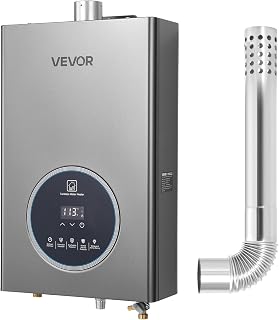
Best for: Homes seeking compact gas-on-demand with precise temperature control. This 4.3-gallon-equivalent unit provides instant hot water with a ±1°F temperature control via LED display and smart temperature management, plus multiple safety protections. Caution: compact footprint may limit simultaneous high-demand usage; ensure adequate gas supply and venting for safe operation.
Buying Guide: Key Considerations for 29–30 Gallon and Gas Hot Water Systems
- Storage vs. tankless: Storage (electric 30-gallon) provides simple installation and immediate hot water but may have standby heat loss. Tankless systems deliver on-demand hot water, saving energy but requiring adequate gas supply and venting for proper sizing.
- Capacity and flow rates: For storage models, 30 gallons suits smaller families (3–5 people). For tankless, match GPM rating to peak simultaneous fixtures (showers, sinks, etc.).
- Fuel source and efficiency: Gas units generally provide faster recovery and lower energy costs in many climates but require venting and space for installation. Electric storage offers straightforward installation but potential higher energy draw.
- Installation considerations: Outdoor vs. indoor placement affects venting, clearance, and weather protection. Professional installation is often recommended for gas units to ensure safety and code compliance.
- Safety features: Look for freeze protection, flame monitoring, overheat protection, anti-dry-fire features, and reliable corrosion-resistant heat exchangers for longevity.
- Maintenance and longevity: Copper heat exchangers and enamel interiors improve durability. Consider max IPX rating for indoor units in damp environments.
Frequently Asked Questions
- What is the difference between a 29-gallon and 30-gallon water heater?
Both are commonly used as standard residential sizes; the primary distinction is labeling and slightly different dimensions. Performance is driven by capacity, insulation, and inlet water temperature rather than the exact gallon rating. - Are gas tankless heaters better for large households?
Yes, gas tankless units with higher GPM and BTU ratings can support multiple fixtures, but proper sizing and venting are essential to meet demand. - Do I need venting for a gas water heater?
Most gas units require proper venting to exhaust combustion gases. Venting requirements depend on the model and installation location; professional installation is advised. - Is an electric 30-gallon heater enough for a family?
For many households, a 30-gallon electric storage heater provides sufficient hot water for daily routines, but recovery time and peak usage should be considered. - What should I check before choosing a tankless gas heater?
Check GPM rating, inlet temperature requirements, minimum flow, and available space for proper venting and gas supply. Ensure compatibility with existing lines and codes. - How does efficiency affect operating costs?
Tankless models with high UEF and precise temperature control typically save energy by heating water only when needed, reducing standby losses compared with traditional storage heaters.